 Written by
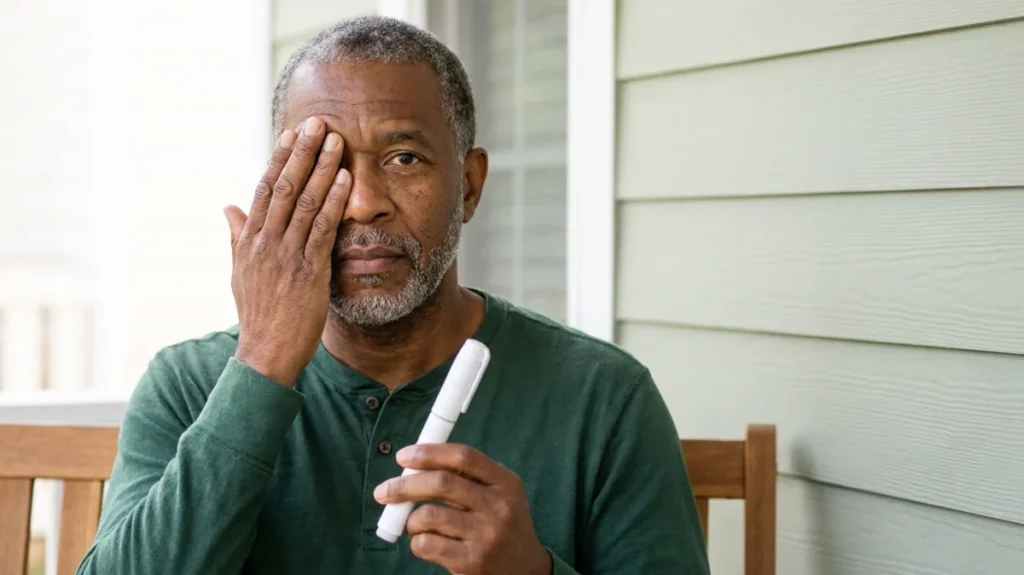
The weekly pen sits in the fridge door, and a headline on your phone says drugs like Ozempic can make people go blind. The real picture is a lot calmer than that, though there’s one warning sign everyone on these drugs should know.
Quick answer: The risk of sudden vision loss on Ozempic looks small. In a Rutgers study of adults with type 2 diabetes, GLP-1 drugs were linked to about three to four extra cases of a rare optic nerve problem per 10,000 users over a year and a half. Any sudden vision loss is an emergency, but don’t stop the drug without talking to your prescriber.
In this article
How big is the risk of sudden vision loss on Ozempic?
The headlines trace back to a Rutgers study in Annals of Internal Medicine. It compared adults with type 2 diabetes who started GLP-1 drugs like Ozempic with people who started other diabetes medicines.
Over about a year and a half, the GLP-1 group had roughly one extra case of the eye problem for every 3,000 people who started one of these drugs. When it does happen, it usually blurs or dims part of the view in one eye rather than causing total blindness.
That makes “Ozempic blindness” a misleading label. For someone who’s been on the drug for a year without trouble, the study is a reason to learn one warning sign, not a reason to panic.
What is this eye problem, in plain words?
The optic nerve is the cable that carries what your eye sees to the brain. In the main problem behind the headlines, blood flow to that nerve suddenly drops and the view in that eye turns blurry, dim or patchy. It’s a bit like a stroke, though doctors don’t count it as one. It usually hits one eye, and it doesn’t hurt.
The medical name is NAION. The Rutgers study counted the whole family of optic nerve blood-flow problems, because its records couldn’t single out NAION, but most of those cases are NAION.
Here’s the frustrating part: vision lost to NAION usually doesn’t fully come back. About a third of people get some of it back, mostly within six months, and there’s no confirmed treatment yet.
Who is more likely to get it?
In the Rutgers study, the extra cases clustered in men and in adults 50 and older, while the added risk in women and younger adults was minimal. That puts a man in his late fifties with type 2 diabetes right where the extra cases showed up. Nobody over 65 was included, so the study’s numbers may not apply to older adults.
Some of the risk has nothing to do with the drug. Type 2 diabetes itself raises the odds of NAION, and so do high blood pressure, high cholesterol and smoking. Eye specialists add untreated sleep apnea and blood pressure that dips too low overnight.
A past episode raises the stakes, too. About 15% of people who’ve had NAION in one eye later get it in the other.
How solid is the evidence?
Here’s the catch: a study like this shows a link, not proof that the drug causes the problem. People who get a GLP-1 drug may have diabetes that’s harder to control, and that alone may raise the risk. The study also lumped all GLP-1 drugs together, so there’s no separate number for Ozempic.
Other large studies have found a similar link, often about double a very low starting risk, and one that followed more than a million patients found none. European drug regulators list NAION as a very rare side effect of Ozempic and other semaglutide medicines, affecting up to 1 in 10,000 people. The U.S. label doesn’t list it, but it does ask patients to report any vision change.
What does it feel like, and when is it an emergency?
Picture waking up to find the lower half of the view in one eye hazy or shadowed, with colors a little washed out, while the other eye looks normal.
Any sudden vision loss, even partial, is an emergency. That’s the one part of this story where waiting is the wrong move. The same symptom can come from a stroke or a detached retina, and both need care right away.
- Sudden blur, dimming or a dark shadow in one eye: go to the emergency room, even if it doesn’t hurt.
- Vision loss with a headache, tender temples or jaw pain when chewing: go to the emergency room. These signs can point to giant cell arteritis, a swelling of the arteries in the head that needs steroid treatment fast.
- Eyesight that’s getting worse quickly: call your doctor without delay and ask for an urgent eye exam. If you can’t be seen that day, go to urgent care or the emergency room.
Wherever you’re seen, mention that you take a GLP-1 drug, since it may not show up in their records.
Should you stop taking Ozempic?
Not on your own, and not because of a headline. The American Academy of Ophthalmology and the North American Neuro-Ophthalmology Society, two leading groups of eye specialists, don’t recommend that everyone stop. For people with hard-to-control diabetes, heart disease or severe obesity, quitting suddenly may carry more risk than a rare eye problem.
Instead, raise it with your prescriber, especially if any of these apply:
- You’ve had NAION or unexplained vision loss in one eye.
- You have diabetic retinopathy, where diabetes has damaged the back of the eye.
- You have sleep apnea or high blood pressure.
If NAION is ever confirmed, European regulators advise stopping semaglutide, while these eye specialist groups favor deciding together with your doctors.
They don’t call for an extra eye exam just to screen for NAION, but the yearly diabetic eye exam still matters. It checks for diabetic retinopathy, a separate problem that Ozempic’s label does warn about: it can temporarily get worse when blood sugar comes down fast. If your last one was more than a year ago, book it this week.
More Helpful Reads You Might Like:
- Ozempic vs Wegovy: Key Differences Explained Simply
- Weight-Loss Drugs: Surprising Benefits Beyond Slimming
- The Unwanted Nightly Symphony: A Guide on How to Stop Snoring
Frequently Asked Questions
Can Ozempic make you go blind?
Total blindness is very unlikely. NAION usually affects one eye and leaves blurring, dimming or a missing patch of vision rather than complete darkness. In the Rutgers study, GLP-1 drugs were linked to about three to four extra cases per 10,000 users over a year and a half, and the vast majority of people never developed it.
Is vision loss from NAION permanent?
Usually, at least in part. About a third of people get some vision back, generally within six months, but most keep some lasting loss. There’s no confirmed treatment, so care centers on controlling risk factors and, when needed, on low-vision aids.
Do Wegovy and Mounjaro carry the same risk?
Wegovy contains semaglutide, the same medicine as Ozempic, and European regulators include it in their very rare NAION listing, along with Rybelsus. That listing covers semaglutide medicines only. Mounjaro is a different drug that wasn’t part of that review, so it isn’t known whether it carries the same signal. Any sudden vision loss still needs emergency care, whatever the brand.
Does blurry vision on Ozempic mean you have NAION?
Not necessarily. NAION comes on suddenly, doesn’t hurt and usually affects one eye. Blurry vision can have other causes, including diabetic retinopathy, which can briefly get worse when blood sugar improves quickly. Tell your prescriber about any vision change. If part of your vision goes dark or blurry all of a sudden, go to the emergency room.
Medical Disclaimer: This content is for educational purposes only and does not replace professional medical advice, diagnosis, or treatment. Always consult your physician or a qualified healthcare provider with any questions about a medical condition.
Sources & Further Reading
How we sourced this article: we rely on peer-reviewed studies, clinical guidelines and public-health agencies (CDC, NIH, AHA, WHO), check every link before publishing, and update articles when the evidence changes. Read our editorial approach.
- Annals of Internal Medicine: Glucagon-like Peptide-1 Receptor Agonists and Risk for Ischemic Optic Neuropathy: A Target Trial Emulation (Reynolds, O’Malley, Roy, Dave)
- Annals of Internal Medicine: Glucagon-like Peptide-1 Receptor Agonists and Risk for Anterior Ischemic Optic Neuropathy: A Nationwide Cohort Study (Ueda et al.)
- European Medicines Agency: PRAC concludes eye condition NAION is a very rare side effect of semaglutide medicines Ozempic, Rybelsus and Wegovy
- Rutgers University: Researchers Find Small Increased Risk of Sudden Vision Loss Associated With GLP-1 Medications
- DailyMed (NLM): OZEMPIC (semaglutide) injection prescribing information and Medication Guide
- American Academy of Ophthalmology: What The Data Say About GLP-1 Drugs and Vision Loss
- UK MHRA Drug Safety Update: Semaglutide (Wegovy, Ozempic and Rybelsus): risk of non-arteritic anterior ischemic optic neuropathy (NAION)
- Cleveland Clinic: Ischemic Optic Neuropathy (ION)
- JAMA Ophthalmology: Risk of Nonarteritic Anterior Ischemic Optic Neuropathy in Patients Prescribed Semaglutide (Hathaway et al.)
- JAMA Ophthalmology: New-Onset Nonarteritic Anterior Ischemic Optic Neuropathy and Initiators of Semaglutide in US Veterans With Type 2 Diabetes (Heberer et al.)