 Written by
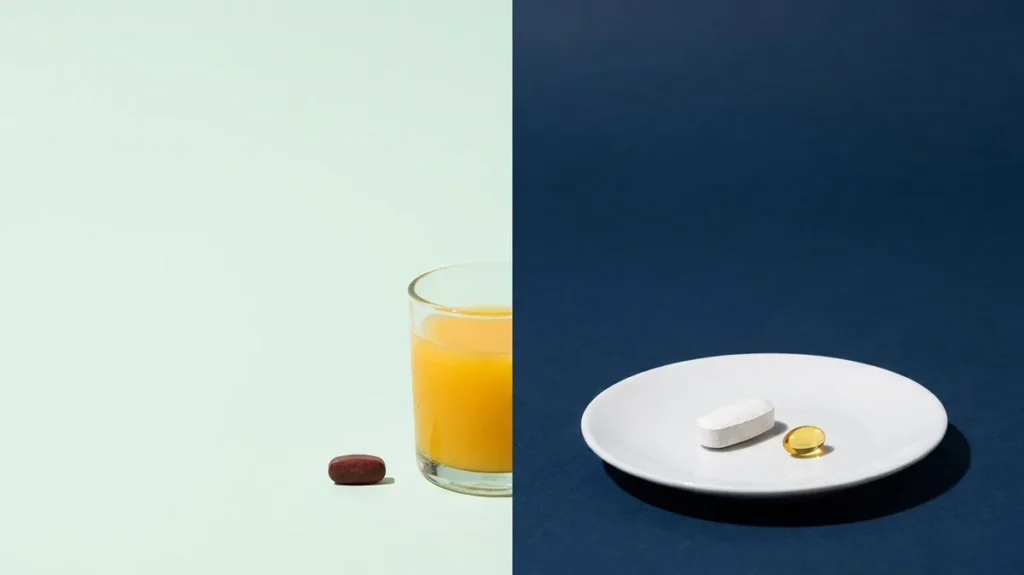
Being told you’re low in both iron and vitamin D usually means leaving with two new bottles and very little advice about fitting them into one day. Vitamin D absorbs best with a bit of fat from a meal, while iron from a pill is pickier. Whatever else is in your stomach at that moment, from coffee to calcium, can shrink how much iron you absorb. If you’re holding both bottles, the good news is that plain vitamin D and iron aren’t known to clash. What deserves a closer look is what comes along with them.
Quick answer: Yes, you can take vitamin D and iron together. Plain vitamin D didn’t change iron levels in a year-long trial of older adults. The real problem is calcium, which many vitamin D products also contain and which can cut iron absorption by about half. Check the label, give iron its own morning slot, and take vitamin D with a meal that has some fat.
In this article
Does plain vitamin D get in iron’s way?
For plain vitamin D, the evidence is reassuring. In a year-long trial of adults 65 and older, people taking vitamin D3 every day saw their vitamin D levels rise. Their iron stores and blood iron, though, looked no different from those of people on a placebo. Iron stores are the ferritin number you may have seen on your lab report. Nobody in that trial was taking an iron pill, so it doesn’t tell you what happens when the two are swallowed together. Still, a full year of vitamin D didn’t pull iron levels down, and no study has shown plain vitamin D blocking an iron pill.
It also means vitamin D isn’t quietly helping your iron along, since iron didn’t go up in that trial either. The thing to watch is calcium, which hides in a lot of vitamin D bottles.
Does the calcium in your vitamin D block iron?
Often, yes, and it’s easy to miss. Many vitamin D products are really calcium-plus-D combos, and calcium is one of the strongest blockers of iron from a pill. Taken alongside an iron pill, a calcium supplement can cut the iron your body absorbs by about half, even on an empty stomach. Results varied with the type of calcium, but when the pills were taken with food, every calcium supplement tested got in iron’s way.
That’s where the vague “take them apart” advice you may have seen online comes from. Turn the bottle around and read the Supplement Facts panel. If calcium shows up anywhere on it, whether as carbonate, citrate or another form, that pill belongs at a different meal or a different part of the day from your iron. Someone who takes iron when they wake up, for example, can save the calcium combo for dinner. If the panel lists vitamin D and little else, it can go wherever it’s easiest to remember.
When should you take iron, and when should you take vitamin D?
Iron does best first thing in the morning, before breakfast, with a glass of water or orange juice. Morning doses tended to absorb better than afternoon ones in women with low iron. The researchers who measured this advise taking iron in the morning, away from meals and coffee.
Coffee is the hard part for most people. Taken with the iron pill, it left only about half as much iron getting through, and breakfast with coffee lowered that even further. Keeping coffee away from the pill is a tough ask before the first cup of the day. The version that tends to stick is iron with water or juice when you get up, and coffee or tea a little later in the morning.
There’s a good reason orange juice keeps coming up. A modest amount of vitamin C, close to what a glass of orange juice holds, helped iron absorb. A big vitamin C tablet added nothing beyond that. The American Gastroenterological Association also advises pairing iron pills with vitamin C, and the juice covers that.
Plain vitamin D is the easy one. Take it with lunch or dinner, or any meal that has some fat in it, whether that’s a turkey sandwich or a plate of pasta with olive oil. In older adults, the same dose raised blood levels of vitamin D more when it was taken with a meal that had some fat than with a fat-free breakfast. The type of fat didn’t matter.
| Pill | When to take it | Take it with | Keep it away from |
|---|---|---|---|
| Iron | Morning, before breakfast | Water or orange juice | Coffee, tea, breakfast and anything with calcium |
| Plain vitamin D | Lunch or dinner | A meal with some fat (absorbs about a third better) | No known conflict with iron |
| Calcium + vitamin D combo | A different meal or time of day from iron | A meal with some fat, for the vitamin D | Your iron pill |
If you also take a thyroid pill
A thyroid pill makes the morning even more crowded. The levothyroxine label asks you to swallow it before you’ve eaten anything, half an hour to an hour ahead of breakfast. It also says to keep iron and calcium supplements at least 4 hours away from it. Both can latch onto the thyroid medicine in the gut and keep your body from absorbing all of it. Plain vitamin D isn’t on that list. Since the thyroid pill and iron both want the early-morning slot, ask your pharmacist to help you work out a schedule that keeps them apart.
Can you take iron every other day?
Yes, and it can be a relief for people whose stomach protests every morning. Each iron dose prompts your body to make more of a hormone called hepcidin, whose job is to tell the gut to take in less iron. It works a bit like a door that swings partly shut for about a day after each pill, so a dose the next morning meets a narrower opening. Skipping a day gives the door time to swing back open. It never closes all the way, which is why daily iron still works.
Guidelines from the American Gastroenterological Association say once a day is the most anyone needs to take iron pills. Every other day is an option some people find easier on the stomach, with similar absorption. Studies that measured exactly how much iron gets in from each pill went a step further. In young women with low iron, each dose was absorbed better when the doses were spaced a day apart. In women who already had anemia, a dose taken every other day delivered nearly half again as much iron as a dose taken every day.
In a six-month trial, young women with low iron stores got the same total amount of iron either daily or every other day. Their iron stores ended up the same, and stomach side effects were less common on the every-other-day schedule. Just know it isn’t a faster route: you’re taking the same number of pills, spread over twice as many days. Splitting one dose into a morning half and an evening half doesn’t help either. It keeps hepcidin high, and no extra iron gets in.
Most of this research was done in young women, so the results are less certain for older adults and during pregnancy. Some people, such as those with active inflammatory bowel disease or those who’ve had weight-loss surgery, may not absorb iron pills well on any schedule. For them, gastroenterology guidelines say IV iron may be needed instead. If daily iron is upsetting your stomach, mention it to your prescriber before you give up on the pills. They can adjust the schedule to one your stomach can live with.
More Helpful Reads You Might Like:
- How Long Does It Take to Recover From Vitamin D Deficiency?
- Still Exhausted on Thyroid Medication? Here’s What Might Be Going On
- The Supplements That Quietly Clash With Your Prescriptions
- Best Vitamins for Energy and Focus: Which One Are You Low In?
Frequently Asked Questions
Can I take vitamin D and iron at the same time in the morning?
Yes. Plain vitamin D hasn’t been shown to block iron, so taking them at the same time isn’t a known problem. Vitamin D just absorbs better with a meal that has some fat, and a vitamin D product that also contains calcium shouldn’t go down with the iron pill.
What vitamins and supplements shouldn’t be taken with iron?
Calcium is the big one, and it often comes bundled with vitamin D, so read the label before pairing the two. Coffee also shrinks how much iron you take in, and coffee with breakfast shrinks it more. Vitamin C works the other way and gives iron a modest boost.
How long after taking iron can I drink coffee?
No study has pinned down an exact wait. What’s clear is that in women with low iron, coffee taken with the pill halved how much iron they absorbed. Swallow the iron with water or juice when you wake up, and have your coffee later in the morning.
Should I take iron with orange juice?
It’s a good choice. One glass carries roughly the amount of vitamin C that helped iron absorb in women with low iron, and a much bigger dose added nothing more.
Can I take iron and vitamin D if I’m on thyroid medication?
Yes, but the thyroid pill needs its own slot. Its label calls for an empty stomach before breakfast and at least 4 hours between it and any iron or calcium supplement. Plain vitamin D isn’t on that list, but a calcium-plus-D combo counts as a calcium supplement.
Medical Disclaimer: This content is for educational purposes only and does not replace professional medical advice, diagnosis, or treatment. Always consult your physician or a qualified healthcare provider with any questions about a medical condition.
Sources & Further Reading
How we sourced this article: we rely on peer-reviewed studies, clinical guidelines and public-health agencies (CDC, NIH, AHA, WHO), check every link before publishing, and update articles when the evidence changes. Read our editorial approach.
- AGA: Management of Iron Deficiency Anemia (AGA Clinical Practice Update)
- Stoffel NU et al. Iron absorption from oral iron supplements given on consecutive versus alternate days and as single morning doses versus twice-daily split dosing in iron-depleted women: two open-label, randomised controlled trials. Lancet Haematol 2017
- Stoffel NU et al. Iron absorption from supplements is greater with alternate day than with consecutive day dosing in iron-deficient anemic women. Haematologica 2020
- von Siebenthal HK et al. Alternate day versus consecutive day oral iron supplementation in iron-depleted women: a randomized double-blind placebo-controlled study. EClinicalMedicine 2023
- von Siebenthal HK et al. Effect of dietary factors and time of day on iron absorption from oral iron supplements in iron deficient women. Am J Hematol 2023
- Cook JD, Dassenko SA, Whittaker P. Calcium supplementation: effect on iron absorption. Am J Clin Nutr 1991;53:106-111
- Lamikanra AA et al. Effect of supplementation with vitamin D on biochemical markers of iron status and erythropoiesis in older people: BEST-D trial. Br J Nutr 2025
- Dawson-Hughes B et al. Dietary fat increases vitamin D-3 absorption. J Acad Nutr Diet 2015;115:225-230
- DailyMed: Levothyroxine sodium tablets, USP – prescribing information
- MedlinePlus Genetics: HAMP gene (hepcidin)