
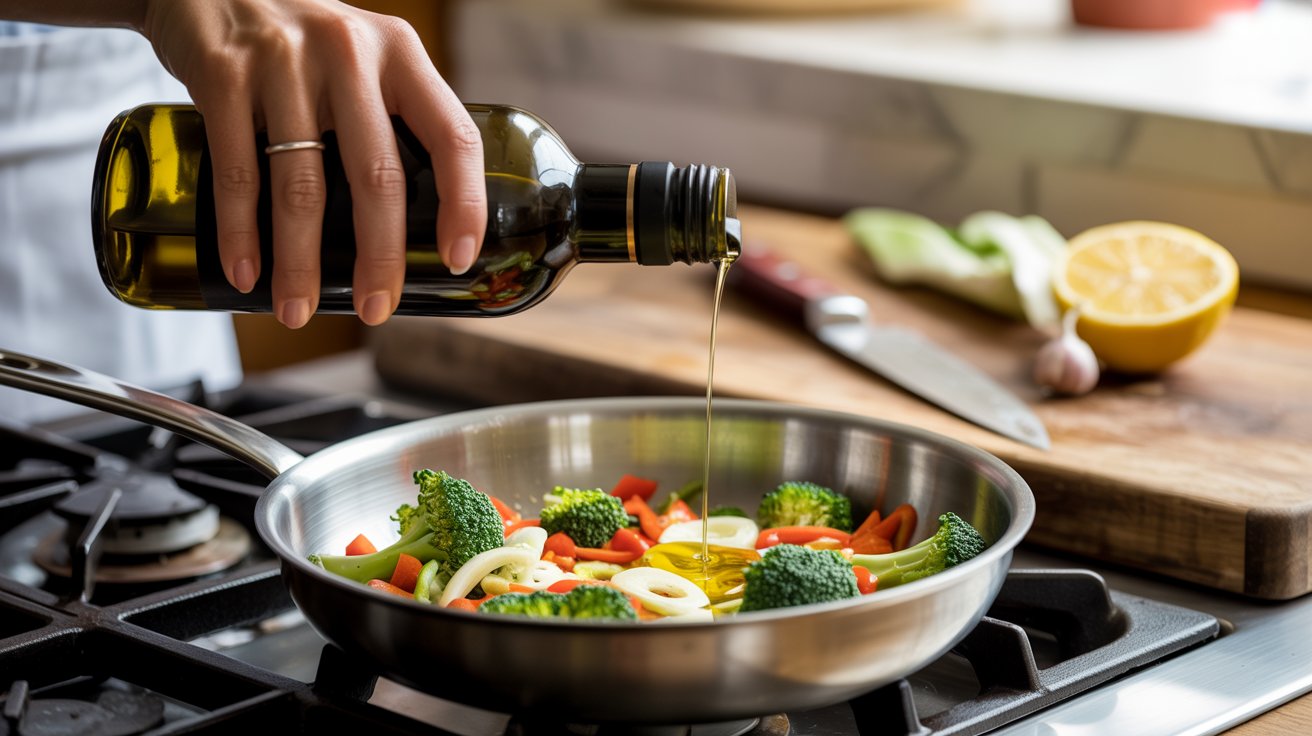
You’re standing in your kitchen, ready to sauté some fresh vegetables for a healthy weeknight dinner. You reach for the bottle of extra virgin olive oil, but then you pause. A well-meaning friend’s voice echoes in your mind: “Don’t you know you’re not supposed to heat olive oil? It becomes unhealthy!”
This is a common kitchen dilemma, one that leaves many health-conscious individuals feeling uncertain. The golden liquid, celebrated for its central role in the heart-healthy Mediterranean diet, suddenly seems fraught with risk when it meets a hot pan. Does heating this beloved oil truly strip it of its benefits and turn it into something harmful? It’s time to separate fact from fiction and bring clarity to your cooking with evidence-based insights.
The Science of Heating Oils: Smoke Point vs. Stability
To understand what happens when you cook with olive oil, it’s essential to grasp two key concepts: smoke point and oxidative stability. For years, the conversation has been dominated by the smoke point, but emerging science suggests that stability is a far more critical factor for a healthy cooking oil.
Deconstructing the Smoke Point
The smoke point is the temperature at which an oil stops shimmering and starts to break down, producing a continuous stream of smoke. When this occurs, the fats are undergoing a process called pyrolysis, which can lead to the formation of potentially harmful compounds, including aldehydes. Many people believe that a high smoke point is the single most important quality of a cooking oil.
Different oils have different smoke points. For instance:
- Extra Virgin Olive Oil: 350-410°F (175-210°C)
- Refined Olive Oil: 390-470°F (199-243°C)
- Canola Oil: 400°F (204°C)
- Avocado Oil: 520°F (271°C)
At first glance, it might seem that oils with higher smoke points are superior for cooking. However, the smoke point is not a fixed number; it can be influenced by the quality of the oil, its age, and the presence of free fatty acids. More importantly, most home cooking methods rarely exceed the temperatures needed to reach olive oil’s smoke point. A typical pan-fry or sauté is done around 350°F (175°C), well within the safe range for good quality extra virgin olive oil.
More Helpful Reads You Might Like:
The Unsung Hero: Oxidative Stability
This is where the story gets more interesting. Oxidative stability refers to an oil’s resistance to reacting with oxygen when heated. When an oil with poor stability is heated, it can undergo oxidation, producing harmful compounds like polar compounds and aldehydes, which have been linked to various health concerns. An oil’s stability is determined by its chemical structure—specifically, the types of fatty acids it contains—and its antioxidant content.
Olive oil is predominantly composed of monounsaturated fats (mainly oleic acid), which are much more stable and resistant to heat than the polyunsaturated fats found in many common seed oils (like soybean, corn, and sunflower oil). Furthermore, extra virgin olive oil is rich in natural antioxidants, including polyphenols and vitamin E. These powerful compounds don’t just protect our bodies from damage; they also protect the oil itself from breaking down when heated.
In essence, the antioxidants in EVOO act as a protective shield, sacrificing themselves to prevent the fats from oxidizing. This makes extra virgin olive oil remarkably stable under typical cooking conditions.
What the Evidence Says: Olive Oil Can Take the Heat
Recent scientific research has consistently challenged the myth that olive oil is unsuitable for cooking. In fact, studies show it to be one of the safest and most stable choices you can make.
A groundbreaking 2018 study published in the journal Acta Scientific Nutritional Health compared ten common cooking oils, including extra virgin olive oil, canola oil, and coconut oil. The researchers heated the oils and measured the production of polar compounds, which are byproducts of oil degradation. The results were clear: extra virgin olive oil was the most stable oil, producing the lowest levels of harmful polar compounds, even outperforming oils with higher smoke points.
Do the Antioxidants Survive?
One of the primary concerns is that heating will destroy the precious antioxidants that make EVOO so healthy. While it’s true that some of these compounds are heat-sensitive, the loss is not as dramatic as many believe. A 2016 study that simulated home cooking conditions found that many of olive oil’s most potent compounds, such as oleocanthal, hydroxytyrosol, and oleuropein, were “reasonably heat-resistant.”
Furthermore, a fascinating 2015 study revealed that when you cook vegetables in extra virgin olive oil, the beneficial phenols and antioxidants from the oil are actually transferred to the food. So, while the oil itself may experience a slight reduction in its antioxidant profile, your vegetables are getting a nutritional upgrade. It’s a win-win scenario where the oil enriches the food it’s cooking.
Even after some loss during heating, high-quality extra virgin olive oil still retains a higher antioxidant content compared to most other cooking oils, which have very few to begin with. You are starting from a much higher baseline of beneficial compounds.
Practical Guidance for Your Kitchen
Understanding the science is reassuring, but how does this translate to your daily cooking? Here are some practical, evidence-based tips for using olive oil with confidence.
Choose the Right Olive Oil for the Job
•Extra Virgin Olive Oil (EVOO): This is the highest quality, least processed form of olive oil, boasting the richest flavor and highest antioxidant content. It is ideal for sautéing, pan-frying, roasting, and, of course, for raw applications like dressings and finishing drizzles. Its robust flavor can enhance a wide variety of dishes.
•Refined or “Light” Olive Oil: This type of olive oil has been processed to give it a more neutral flavor and a higher smoke point. While it lacks the antioxidant punch of EVOO, it can be a suitable choice for high-heat applications like searing or when you don’t want a strong olive flavor in your dish.
Best Practices for Cooking with Olive Oil
1. Don’t Be Afraid of the Heat (to a Point): Feel confident using extra virgin olive oil for most of your stovetop cooking. A good rule of thumb is to keep the heat at a medium level. You want to see a gentle shimmer in the oil, not billowing smoke.
2. Avoid Reusing Oil: Repeatedly heating any oil will degrade its quality and lead to the formation of harmful compounds. It is always best to use fresh oil for each cooking session.
3. Store It Properly: Light and heat are the enemies of olive oil. Store your bottle in a cool, dark place—like a pantry, not next to the stove—to preserve its quality and antioxidant content. A dark glass bottle or a tin is preferable to clear glass.
4. Listen to Your Senses: If your oil smells rancid, waxy, or like crayons, it has gone bad. Cooking with rancid oil will not only ruin the taste of your food but also introduce oxidized fats into your meal. When in doubt, throw it out.
Signs the Heat Is Too High
If you do happen to overheat your oil, you’ll know it. The most obvious sign is a continuous stream of smoke. If this happens, it’s best to discard the oil, wipe the pan, and start over at a lower temperature. A little wisp of smoke is not a cause for alarm, but a smoking pan is a clear signal that the oil is breaking down.
The Verdict: Cook with Confidence
So, does heating olive oil in a pan make it unhealthy? The overwhelming body of scientific evidence says no. The notion that this liquid gold should be confined to salad dressings is a persistent myth that overlooks the remarkable stability of olive oil, particularly the extra virgin variety.
Thanks to its high concentration of heat-stable monounsaturated fats and a powerful army of antioxidants, extra virgin olive oil stands up beautifully to the heat of everyday cooking. Not only does it maintain its healthful properties, but it can also make your food even more nutritious.
So, the next time you’re in your kitchen, you can reach for that bottle of extra virgin olive oil with confidence. Your body—and your taste buds—will thank you for it.
Medical Disclaimer: This content is for educational purposes only and does not replace professional medical advice, diagnosis, or treatment. Always consult your physician or a qualified healthcare provider with any questions about a medical condition.
Frequently Asked Questions (FAQ)
Can I deep-fry with extra virgin olive oil?
While you can, it might not be the most economical choice. Deep-frying requires a large amount of oil, and given the higher cost of high-quality EVOO, a more refined olive oil or another stable oil might be more practical. However, from a safety and stability standpoint, EVOO can handle deep-frying temperatures (typically 350-375°F).
Does the color of olive oil indicate its quality?
The color of olive oil can range from vibrant green to a pale yellow, and it is not a reliable indicator of quality. The color is influenced by the variety of the olive, the ripeness at harvest, and the chlorophyll content. A better indicator of quality is the taste—a good EVOO should have a fresh, fruity, and slightly peppery flavor.
What’s the difference between “light” olive oil and extra virgin olive oil?
“Light” refers to the flavor, not the calorie content. Light olive oil is a refined oil that has been processed to have a neutral taste and a higher smoke point. Extra virgin olive oil, on the other hand, is unrefined and made from the first cold pressing of olives, retaining its natural flavor, aroma, and high antioxidant content.
If my olive oil becomes cloudy in the fridge, has it gone bad?
No, this is a normal process. The cold temperature causes the natural waxes and monounsaturated fats in the oil to solidify. Simply leave the bottle at room temperature for a short time, and it will return to its clear, liquid state with no impact on its quality or flavor.
Sources & Further Reading
1. De Alzaa, F., Guillaume, C., & Ravetti, L. (2018). Evaluation of Chemical and Physical Changes in Different Commercial Oils during Heating. Acta Scientific Nutritional Health, 2(6). https://actascientific.com/ASNH/pdf/ASNH-02-0083.pdf
2. Lozano-Castellón, J., et al. (2020). Domestic Sautéing with EVOO: Change in the Phenolic Profile. Molecules, 25(13), 3025. https://www.mdpi.com/1420-3049/25/13/3025
3. Harvard Health Publishing. (2023). Choosing heart-healthy oils for home cooking. https://www.health.harvard.edu/heart-health/choosing-heart-healthy-oils-for-home-cooking
5.Mayo Clinic. (2023). Mediterranean diet for heart health. https://www.mayoclinic.org/healthy-lifestyle/nutrition-and-healthy-eating/in-depth/mediterranean-diet/art-20047801
6.U.S. Food & Drug Administration (FDA). (2018). FDA Completes Review of Qualified Health Claim Petition for Oleic Acid and the Risk of Coronary Heart Disease. https://www.fda.gov/food/cfsan-constituent-updates/fda-completes-review-qualified-health-claim-petition-oleic-acid-and-risk-coronary-heart-disease
7.American Heart Association. Healthy Cooking Oils.