 Written by
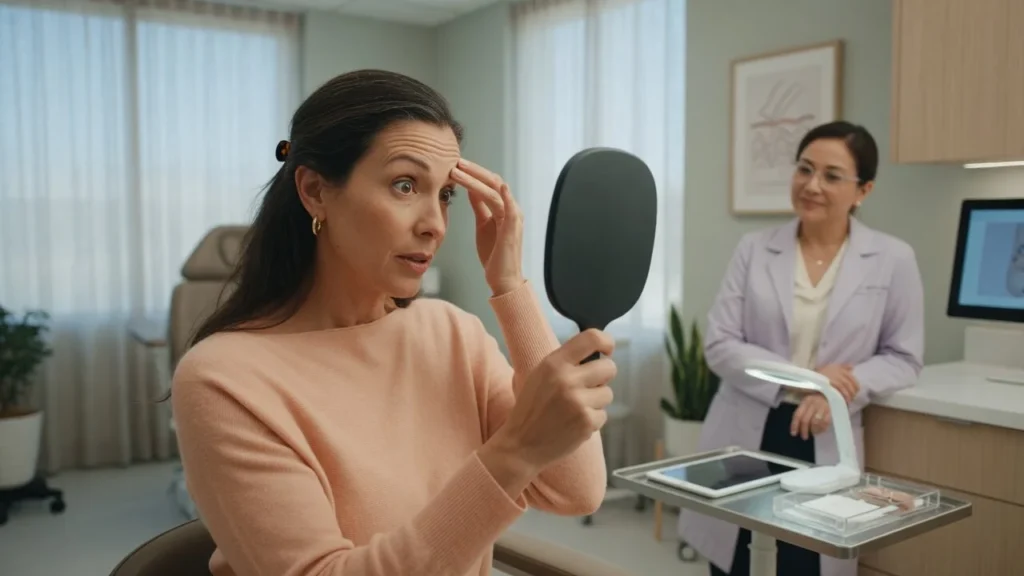
A frozen forehead usually gets blamed on “too much Botox,” but where the toxin goes matters just as much. Botox softens lines by blocking the nerve signal that tells a muscle to tighten, so the skin over it creases less. The block doesn’t last forever: the nerve slowly grows new connections, which is why the effect wears off. If you’re about to book a first visit, or you’re staring at heavy brows a week after one, the real question is which muscles get relaxed, and by how much.
Quick answer: A frozen or droopy look usually comes from too much toxin or the wrong placement. The classic mistake is weakening the forehead muscle, your only brow lifter, without also relaxing the muscles that pull your brows down. Natural-looking Botox softens lines while your face still moves. Judge it after about 2 weeks, and anything that looks off fades in about 3 to 4 months.
In this article
What makes Botox look frozen or “done”?
Your brows sit in the middle of a tug-of-war. The forehead muscle is the only one pulling them up, while the frown muscles between your brows and the outer part of the muscle around each eye pull them down. Botox weakens a muscle only partly and only for a few months, so it shifts that balance without cutting the rope. Shift it too far, or unevenly, and you get the looks people dread:
- Heavy or lowered brows: too much toxin in the forehead, or toxin placed too low, tires out the lone lifter, and the brows sink.
- A flat, blank forehead: the lifter is weakened so much that your brows barely move when you’re surprised or happy.
- The “Spock” brow: uneven weakening near the outer brow lets the tail shoot up into a sharp arch.
Placement is something the FDA label for Botox Cosmetic addresses directly: it says forehead lines should be treated together with frown lines, to lower the chance of a dropped brow. A recent consensus statement from a panel of experienced injectors, including dermatologists and eye surgeons, put it bluntly: one injection pattern used on every face gives poor results.
Some faces start with less room for error. If your upper lids are heavy or hooded, you may be lifting your brows all day without noticing, just to see clearly. Relax that muscle and the support goes with it, a risk the panel singles out in older patients.
What does natural-looking Botox look like, and when can you judge it?
A natural result looks like you after a good night’s sleep. The lines soften, but you can still raise your brows when something surprises you, and your face still shows what you feel.
Timing causes a lot of needless worry. The effect starts a day or two after the injection and keeps building through the first week, so a mirror check on day 2 doesn’t show the final result. The same panel suggests an optional review visit about 2 to 3 weeks out. That’s common practice among experienced injectors, not something the label requires. At that visit, you and the injector look at what worked, sometimes even out an uneven brow, and plan changes for next time.
Photos beat memory here. It helps to have pictures taken before the first treatment, once with your face relaxed and once frowning, so both of you can see what actually changed.
| When | What’s happening | What it means for you |
|---|---|---|
| Days 1-2 | The effect begins | Too early to judge |
| First week | The smoothing keeps building | Your look is still changing |
| About 2-3 weeks | A common check-in time | Compare with your before photos and plan next time |
| About 3-4 months | The whole effect wears off | Anything you didn’t like is gone |
How can you lower the odds of a frozen or droopy result?
Most of what helps happens before the needle ever touches your skin. A good first visit starts with your face in motion. The injector should watch you raise your brows, frown and squint, since your brows need to be checked both at rest and while you move. And if you came in hoping only to smooth your forehead lines, don’t be surprised when the plan includes the frown area too. That pairing is what the label calls for to protect your brow position. The plan should also include a follow-up visit a few weeks later to fine-tune things, since getting it perfect in one sitting is a lot to ask. Going in stages makes sense because toxin can’t be taken back out once it’s in, though no trial has tested the approach.
A few things are worth bringing up at that visit, because each one changes the plan:
- Heavy or hooded lids, or a sense that you lift your brows to see well
- A brow or eyelid that already droops, which the label says calls for extra caution
- Muscle relaxants, certain strong antibiotics, or a neuromuscular disorder such as myasthenia gravis, all of which can strengthen the toxin’s effect
The injector’s experience shows up in the numbers. By one review’s rough estimate, fewer than 1 in 100 people treated by experienced injectors get a droopy lid, and the rate is more than five times higher with beginners. No particular certificate on the wall has been shown to guarantee a natural look, so it’s fair to ask how often the person holding the syringe does these injections.
Counterfeit Botox bought from unlicensed sources has put people in the hospital, according to the FDA. Even a licensed provider isn’t a guarantee: the CDC recently described a medical spa where patients got a toxin that wasn’t FDA-approved and never knew it. You’re entitled to ask whether the product is FDA-approved and comes from an authorized source, and to watch it drawn up from a labeled vial. A carton that isn’t in English, or an injection offered outside a medical office, is a reason to say no.
What if your brow feels heavy or an eyelid droops after Botox?
A heavy brow and a droopy eyelid can look alike in the mirror, but they come from different places. The brow drops when the forehead lifter was weakened too much. The lid sits outside the tug-of-war. It droops when a little toxin spreads through the tissue to the small muscle that raises the eyelid, and that can happen even with a skilled injector.
A droopy lid usually shows up between day 3 and day 14 after the injection. Most cases fade in 3 to 4 weeks, though full recovery can take up to 3 months. If it happens, call your injector. Prescription eye drops can lift the lid a millimeter or two for a few hours by working on a small backup muscle inside it. They don’t speed up recovery, and they do nothing for a lowered brow. Double or blurry vision is also a reason to call; it’s usually a local effect, but it can be an early sign that the toxin has spread.
Trouble swallowing, speaking or breathing, or new weakness elsewhere in your body, in the hours to weeks after an injection is a different matter: get medical help right away.
One thing surprises a lot of people: there’s no shot that undoes Botox. The antitoxin used for botulism only catches toxin still in the bloodstream, so it can’t reverse weakness that’s already set in, according to the CDC. A whole new round of shots isn’t a tested fix either, since the label notes that treatment more often than every 3 months hasn’t been studied. What does work is time, and for a heavy brow it’s the only remedy with solid evidence behind it. As the nerve endings reconnect, your brows lift and your face moves again; according to the label, the effect lasts about 3 to 4 months in all.
More Helpful Reads You Might Like:
- Peptides for Skin Longevity: How They Really Support Aging Skin
- 5 Dermatologist-Recommended Products for Younger-Looking Skin
Frequently Asked Questions
How long does it take for Botox to settle?
Give it about two weeks before you judge it. Botox starts working within a day or two but keeps getting stronger for about a week, so what you see early isn’t the final look. The optional check-in comes two to three weeks out.
Why does my forehead feel heavy after Botox, and how long will it last?
Usually the muscle that lifts your brows was weakened more than the muscles that pull them down, or the toxin was placed too low. There’s no proven quick fix. The heaviness eases as the nerves recover, and the effect wears off in about 3 to 4 months.
Can bad Botox be reversed?
Not with a shot. Botulism antitoxin only works on toxin still circulating in the blood, not on toxin already acting on the nerves. The effect fades on its own, and prescription eye drops can briefly lift a droopy eyelid, though not a lowered brow.
How do you avoid the frozen look with Botox?
Look for an injector who watches your face move before choosing where to inject, and expect frown lines to be treated along with forehead lines to protect your brows. Plan on a follow-up visit to adjust, and make sure the product is FDA-approved.
Medical Disclaimer: This content is for educational purposes only and does not replace professional medical advice, diagnosis, or treatment. Always consult your physician or a qualified healthcare provider with any questions about a medical condition.
Sources & Further Reading
How we sourced this article: we rely on peer-reviewed studies, clinical guidelines and public-health agencies (CDC, NIH, AHA, WHO), check every link before publishing, and update articles when the evidence changes. Read our editorial approach.
- FDA: BOTOX Cosmetic (onabotulinumtoxinA) Prescribing Information, revised October 2024
- Goodman GJ et al. Botulinum Toxin: Surely, We Can Do Better? Optimizing Results Beyond On-Label Techniques and Teaching. Aesthet Surg J Open Forum
- Nestor MS et al. Botulinum toxin-induced blepharoptosis: Anatomy, etiology, prevention, and therapeutic options. J Cosmet Dermatol
- Freixo S, Camões-Barbosa A. Management of Complications Following Botulinum Toxin Facial Injections: A Narrative Review. Cureus
- FDA: Counterfeit Version of Botox Found in Multiple States
- CDC MMWR Notes from the Field: Investigation of Unapproved Botulinum Toxin Product Administered at a Medical Spa, 2025-2026
- CDC: Guidance for Illness Related to ‘DIY’ Injection of Botulinum Toxin
- Glogau R et al. OnabotulinumtoxinA: a meta-analysis of duration of effect in the treatment of glabellar lines. Dermatol Surg
- CDC Health Alert Network: Adverse Effects Linked to Counterfeit or Mishandled Botulinum Toxin Injections (HAN-00507)
- American Academy of Dermatology: Botulinum toxin therapy overview