Artificial intelligence is no longer science fiction in medicine. From reading X-rays to analyzing complex medical records, AI diagnosing disease is already happening in hospitals across the United States.
But a question continues to surface: Can AI actually diagnose disease better than doctors?
The answer is more nuanced than headlines suggest. Some studies show impressive performance. Others highlight important limitations. Major U.S. medical organizations urge caution — and collaboration.
Here’s what the evidence truly shows.
How AI Diagnosing Disease Actually Works
AI diagnosing disease relies on machine learning — a type of computer system trained on massive amounts of medical data. These systems analyze patterns in imaging, lab results, electronic health records, and even pathology slides.
Machine Learning and Pattern Recognition
In simple terms, AI systems are trained on thousands — sometimes millions — of examples. For instance, an AI tool learning to detect pneumonia on chest X-rays studies labeled images showing both normal lungs and infected lungs.
Over time, the system learns subtle visual patterns that may be difficult for the human eye to quantify.
Unlike physicians, AI does not get tired. It does not experience cognitive bias or distraction. It processes data at extraordinary speed.
However, AI also lacks context. It does not speak with patients. It does not interpret body language. It does not weigh social factors, financial barriers, or emotional nuance.
Where Artificial Intelligence in Healthcare Is Already Used
According to the U.S. Food and Drug Administration (FDA), hundreds of AI-enabled medical devices are already authorized — most in radiology and cardiology.
Common current applications include:
- Detecting breast cancer on mammograms
- Identifying stroke on brain imaging
- Flagging abnormal heart rhythms
- Screening diabetic eye disease
- Prioritizing urgent scans in emergency departments
In these narrow tasks, artificial intelligence in healthcare has demonstrated impressive technical performance.
But diagnosing disease is more than identifying an abnormal image.
More Helpful Reads You Might Like:
What Studies Say About AI vs Doctors Diagnosis
The real debate centers on comparative accuracy.
Performance in Controlled Medical Exams
In simulated diagnostic challenges using standardized medical cases, some AI systems have shown very high accuracy.
For example, AI systems tested on structured clinical case vignettes — similar to board exam scenarios — have, in certain studies, matched or even outperformed groups of physicians.
These results often make headlines.
However, controlled exam settings differ significantly from real-world medicine. The cases are clearly written. The data are complete. The “correct answer” is predefined.
Real patients are rarely that straightforward.
Real-World Clinical Settings
When researchers evaluate AI diagnosing disease in real clinical environments, results are more mixed.
Systematic reviews published in high-impact journals such as JAMA Network Open have found that AI performance is often comparable to clinicians in specific tasks, but not consistently superior across broad diagnostic scenarios.
In addition, studies examining whether physicians improve their accuracy when using AI decision-support tools show variable results. In some settings, AI assistance helps. In others, it makes little difference.
Importantly, experienced specialists often still outperform standalone AI systems when complex judgment is required.
Where AI Medical Diagnosis Accuracy Is Highest
Not all specialties are equal when it comes to AI medical diagnosis accuracy.
AI in Radiology and Medical Imaging
Radiology remains one of the strongest areas for AI performance.
Multiple large studies have demonstrated that AI in radiology can:
- Detect lung nodules on CT scans
- Identify breast cancer on mammograms
- Spot fractures on X-rays
- Flag internal bleeding on emergency scans
In some imaging tasks, AI performs at a level similar to board-certified radiologists.
Importantly, research suggests the best outcomes often occur when AI and radiologists work together — not when one replaces the other.
AI may highlight subtle abnormalities. The physician then applies clinical judgment, correlates symptoms, and determines next steps.
This partnership approach tends to reduce missed findings.
Cancer Screening and Early Detection
AI has shown promise in cancer detection, particularly in breast cancer screening.
Studies published in leading journals such as The Lancet Digital Health have reported that AI-assisted mammography can reduce false negatives and false positives when used alongside radiologists.
That balance matters. Overdiagnosis can cause anxiety and unnecessary procedures. Underdiagnosis delays treatment.
Precision is critical.
Can AI Replace Doctors? What Major Medical Organizations Say
Major U.S. medical organizations consistently emphasize that AI is a tool — not a replacement.
The American Medical Association (AMA) supports the responsible integration of artificial intelligence in healthcare but stresses physician oversight, transparency, and patient safety.
The National Academy of Medicine highlights concerns including:
- Algorithmic bias
- Data privacy
- Unequal representation in training data
- Accountability for errors
If an AI system makes a diagnostic mistake, responsibility still falls on clinicians and institutions.
Medicine is not purely computational. It involves ethical reasoning, shared decision-making, and patient trust.
A diagnosis is not just a label. It often leads to life-altering decisions.
That level of responsibility requires human judgment.
The Real Future of AI Diagnosing Disease
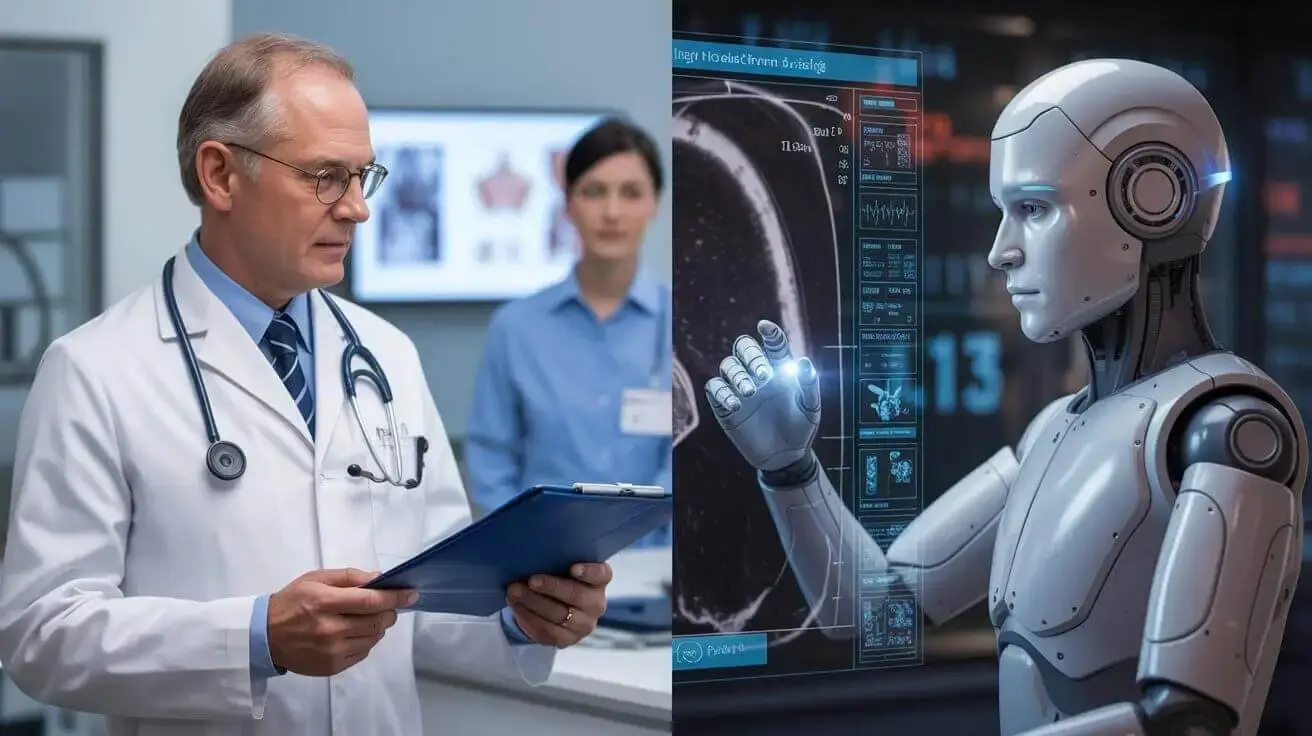
The most realistic future is not AI versus doctors.
It is AI with doctors.
AI diagnosing disease may excel at pattern recognition, data synthesis, and repetitive screening tasks. Physicians excel at contextual reasoning, empathy, ethical decision-making, and adapting to uncertainty.
Research increasingly suggests that collaborative models — where AI acts as a diagnostic assistant — may offer the greatest benefit.
Potential advantages include:
- Faster identification of urgent conditions
- Reduced diagnostic error in high-volume settings
- Earlier detection of subtle disease
- Improved workflow efficiency
But safeguards remain essential. Algorithms must be validated in diverse populations. Performance must be monitored continuously. Clinicians must understand both strengths and limitations.
Patients deserve transparency about how AI is used in their care.
So, Can AI Diagnose Disease Better Than Doctors?
In narrow, well-defined tasks — especially in imaging — AI diagnosing disease can sometimes match or even exceed human performance.
In complex, real-world clinical scenarios requiring judgment, nuance, and patient interaction, physicians remain essential.
The evidence does not support a full replacement model.
Instead, it supports augmentation.
AI is powerful. Physicians are indispensable.
When thoughtfully integrated, artificial intelligence in healthcare may reduce errors, improve efficiency, and expand access to care — while preserving the human core of medicine.
The question may not be whether AI can diagnose disease better than doctors.
The more meaningful question is: How can AI help doctors diagnose disease better together?
Medical Disclaimer
Medical Disclaimer: This content is for educational purposes only and does not replace professional medical advice, diagnosis, or treatment. Always consult your physician or a qualified healthcare provider with any questions about a medical condition.
Sources & Further Reading
- Esteva A, et al. Dermatologist-level classification of skin cancer with deep neural networks. Nature. 2017.
https://pubmed.ncbi.nlm.nih.gov/28117445/ - U.S. Food and Drug Administration – Artificial Intelligence and Machine Learning in Medical Devices
https://www.fda.gov/medical-devices/software-medical-device-samd/artificial-intelligence-and-machine-learning-software-medical-device - Artificial Intelligence vs Clinician Performance in Estimating Probabilities of Diagnoses Before and After Testing — JAMA Network Open (publicado em dezembro de 2023)
- National Academy of Medicine – Artificial Intelligence in Health Care
https://nam.edu/wp-content/uploads/2021/07/4.3-AI-in-Health-Care-title-authors-summary.pdf