 Written by
If your partner has noticed you stop breathing at night and your afternoons have turned into a fight to stay awake, your doctor will likely order a sleep study. These days, that often means a small kit you wear in your own bed instead of a night wired up in a sleep lab. Both tests count how many times an hour your breathing stalls or turns shallow, but only the lab can tell when you’re actually asleep. For most people the kit does the job, but that one difference matters most when a home result comes back normal.
Quick answer: For most adults whose symptoms point strongly to sleep apnea, a home sleep apnea test and a lab study are equally accepted first steps. Daily opioid use, significant heart or lung disease, a past stroke, a neuromuscular condition or severe insomnia call for the lab instead. If the home test is normal, or too patchy to count, and symptoms continue, a lab study comes next.
In this article
What happens in a home sleep apnea test vs. a night in the sleep lab?
What you wear at home, and what the lab adds
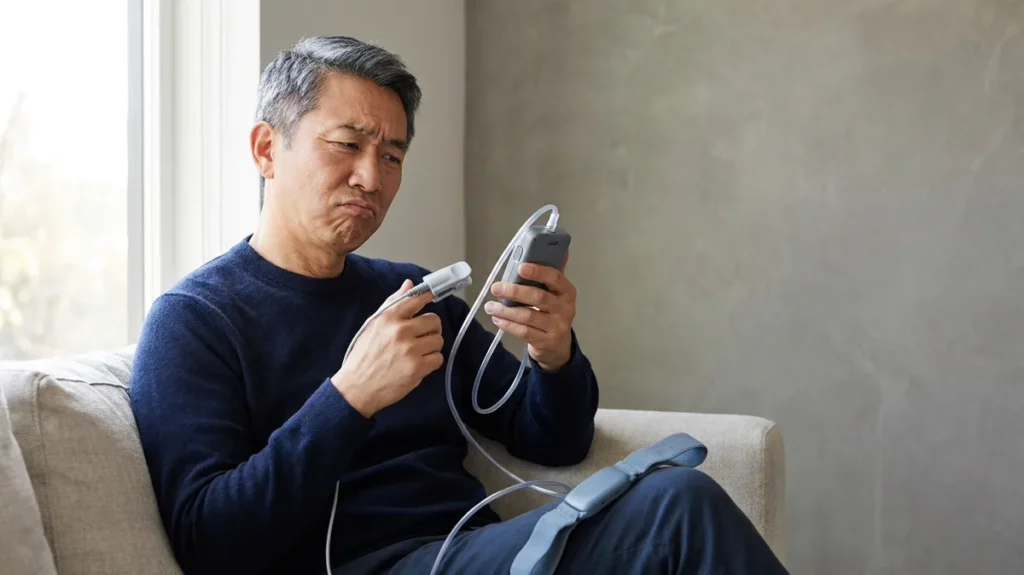
The home kit comes with a few sensors you put on yourself at bedtime. A thin tube under your nose tracks airflow, and stretchy belts around your chest and belly show how hard you’re working to breathe. A clip on one finger reads your oxygen. You sleep in your own bed, with your own pillow, and the device goes back the next day.
An in-lab sleep study, called polysomnography, records all of that plus brain waves, eye movements, chin muscle tone, heart rhythm and leg movements, while a technologist watches overnight. It’s a lot of wires for one night, and nobody pretends it’s restful. Those brain waves are the lab’s real advantage, though, because they show exactly when you fell asleep and when you woke up.
Either test is an accepted first step for adults who are otherwise in good health and whose symptoms fit sleep apnea, according to the American Academy of Sleep Medicine. In the guideline’s terms, that means daytime sleepiness plus at least two of three things: loud snoring, pauses or gasping someone has noticed, or high blood pressure. A person whose partner has started nudging them every time the snoring goes quiet, and who nods off in afternoon meetings, fits that picture well. The kit is less reliable when the symptoms are vaguer, so it’s saved for people whose story is a clear match.
| What to know | Home sleep apnea test | In-lab sleep study |
|---|---|---|
| Where you sleep | Your own bed; you put the sensors on yourself | A bed at a sleep lab, with a technologist watching overnight |
| What it records | Airflow, breathing effort and oxygen, or signals from a finger pulse sensor on some kits; usually can’t tell when you’re asleep | All of that plus brain waves, eye and leg movements, chin muscle tone and heart rhythm |
| What it can diagnose | Obstructive sleep apnea only | Sleep apnea and other sleep disorders |
| How much recording it needs | At least 4 hours | A full monitored night |
| Cost | Lower | Higher |
What a normal home result can miss
The home test’s weak spot is the normal result. One large U.S. trial compared home and lab testing in adults with strong symptoms of sleep apnea. Nearly 1 in 3 of those whose home result looked normal or mild had moderate or worse sleep apnea in the lab. So for someone who still has symptoms, the guideline calls for a lab study after a home test that’s normal, unclear or too patchy to count. A second home kit isn’t the usual next step.
If the snoring, the pauses your partner hears and the daytime drowsiness are still there after a normal home result, that result only means the kit didn’t catch anything that night. A home kit also looks for just one problem, obstructive sleep apnea. It does a poor job with other breathing problems during sleep, and it can’t diagnose sleep disorders that have nothing to do with breathing, such as leg-movement disorders.
Who should skip the home test and go straight to the lab?
The guideline names six situations where an overnight lab study should be the first test, mostly because a home kit can’t sort out what’s going on.
- Significant heart or lung disease, such as heart failure or COPD.
- Weak breathing muscles from a neuromuscular condition.
- Shallow breathing that lets carbon dioxide build up in your blood, whether it shows up during the day or your doctor suspects it only happens at night.
- Daily opioid pain medicine, which raises the risk of breathing pauses that start in the brain instead of a blocked airway. A home kit can’t reliably tell those apart from the usual kind.
- A past stroke.
- Severe insomnia, because a home test counts the hours you spend lying awake as sleep, which makes your breathing score look better than it is.
If none of those fit you, the home test holds up well. The same U.S. trial left out people with the conditions above. Among everyone else, those who did it all at home, from the test to starting CPAP, did as well as those who went to the lab. They stuck with the machine at least as well, and their daytime sleepiness eased just as much.
Few people think to mention a pain prescription or an old stroke at a visit about snoring. So bring them up when your doctor orders the test.
What does the AHI on your report mean, and why can a home test read lower?
Both tests boil the night down to one number, the AHI. It counts how many times an hour your breathing stopped or turned shallow. On the report, under 5 is normal, 5 to under 15 is mild, 15 to under 30 is moderate, and 30 or more is severe. If you have the usual symptoms, a score of 5 or more is enough for a diagnosis. At 15 or more, it counts as sleep apnea even if you feel fine.
A home kit usually doesn’t know when you’re asleep, so it divides your breathing events by the hours it recorded instead of the hours you slept. It’s like figuring out your average speed on a road trip using the whole trip time, gas-station stops included. The drive was the same, but the average comes out lower. A lab study counts only the hours you were actually asleep.
Home kits also miss shallow-breathing spells that show up only as a brief wake-up in the brain, the kind you never remember. A sensor that slips off at night leaves holes in the data. A home test only counts with at least 4 hours of good recording, so keep the sensors snug through your usual night.
How does insurance treat home vs. lab testing?
Coverage varies from plan to plan. If you’re on Medicare, a home test result is accepted when deciding whether you qualify for CPAP, so you don’t need a lab night for that. Many private insurers steer people toward home testing first. The American Academy of Sleep Medicine reviewed insurers’ written policies and found a handful of common problems. One was a rule requiring two failed home tests before the plan would approve a lab study, which is stricter than the guideline.
That rule matters most if you’re in one of the six lab-first groups, or if your home test came back normal while the snoring and sleepiness keep going. Being told to repeat a test that already missed the problem can feel like going in circles. In either case, your doctor’s office can cite the guideline when asking your insurer to approve the lab study.
More Helpful Reads You Might Like:
- Why Am I Snoring More Than Usual? What Your Body May Be Telling You
- Why Do I Feel Tired After 8 Hours of Sleep?
Frequently Asked Questions
Can a home sleep test miss sleep apnea?
It can. A kit worn at home usually can’t detect whether you’re actually asleep, so restless hours awake pull your score down, and some subtle breathing events slip past it. When symptoms outlast a normal home result, the sleep medicine guideline points to an overnight lab study.
Do you need a prescription for a home sleep apnea test?
Yes. A clinician orders it after asking about your sleep and examining you, so it isn’t a kit you buy and read on your own. A board-certified sleep doctor then reviews the actual recording instead of relying on the machine’s automatic score.
How many hours do you need to sleep for a home sleep test to count?
The device needs at least 4 hours of clean recording during your usual sleep time. If a sensor slips off or the night runs too short, the test counts as inadequate, and the usual next step is a study in a sleep lab.
What is a normal AHI on a sleep study?
Anything under 5 an hour is normal. The AHI tallies each time your breathing stops or turns shallow, and sleep apnea is graded mild from 5, moderate from 15 and severe from 30. With the typical symptoms, a score of 5 or more is enough for a diagnosis.
Does insurance cover a home sleep test or a sleep lab?
Plans differ. Many private insurers want a home test first, and Medicare accepts a home result when deciding on CPAP coverage. Some plans ask for two failed home tests before paying for a lab night. That’s stricter than the guideline, which your doctor’s office can cite when asking for approval.
Medical Disclaimer: This content is for educational purposes only and does not replace professional medical advice, diagnosis, or treatment. Always consult your physician or a qualified healthcare provider with any questions about a medical condition.
Sources & Further Reading
How we sourced this article: we rely on peer-reviewed studies, clinical guidelines and public-health agencies (CDC, NIH, AHA, WHO), check every link before publishing, and update articles when the evidence changes. Read our editorial approach.
- American Academy of Sleep Medicine: Clinical Practice Guideline for Diagnostic Testing for Adult Obstructive Sleep Apnea (Kapur et al., J Clin Sleep Med 2017;13(3):479-504)
- American Academy of Sleep Medicine: Clinical use of a home sleep apnea test, an updated position statement (Rosen et al., J Clin Sleep Med 2018;14(12):2075-2077)
- Missouri Medicine: Home Sleep Apnea Testing for Obstructive Sleep Apnea (Hussein et al., Mo Med 2024;121(1):60-65)
- Sleep: A multisite randomized trial of portable sleep studies and positive airway pressure autotitration versus laboratory-based polysomnography (HomePAP; Rosen et al., Sleep 2012;35(6):757-767)
- Centers for Medicare & Medicaid Services: National Coverage Determination for CPAP Therapy for Obstructive Sleep Apnea (240.4)
- Journal of Clinical Sleep Medicine: Addressing gaps between payer policies and AASM clinical practice guidelines using scorecards (Kaplish et al., 2020;16(5):811-815)
- U.S. Preventive Services Task Force: Obstructive Sleep Apnea in Adults: Screening
- U.S. Food and Drug Administration: 510(k) K250460, WatchPAT400 (WP400) home sleep device
- MedlinePlus: Sleep Study