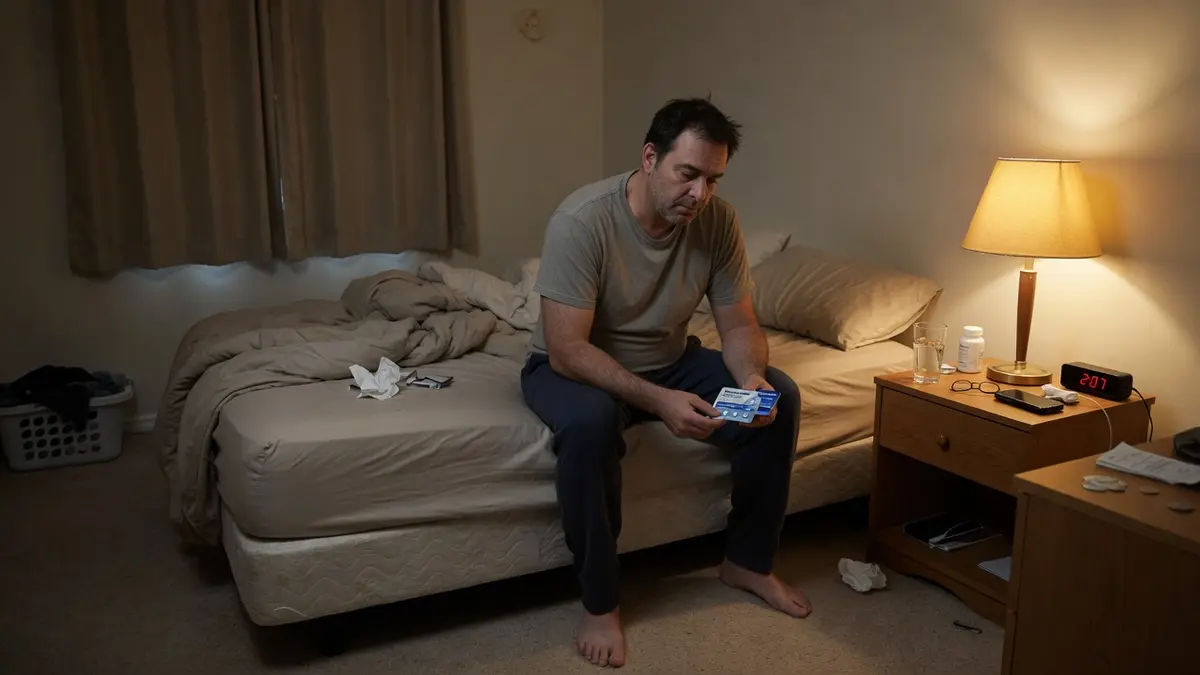
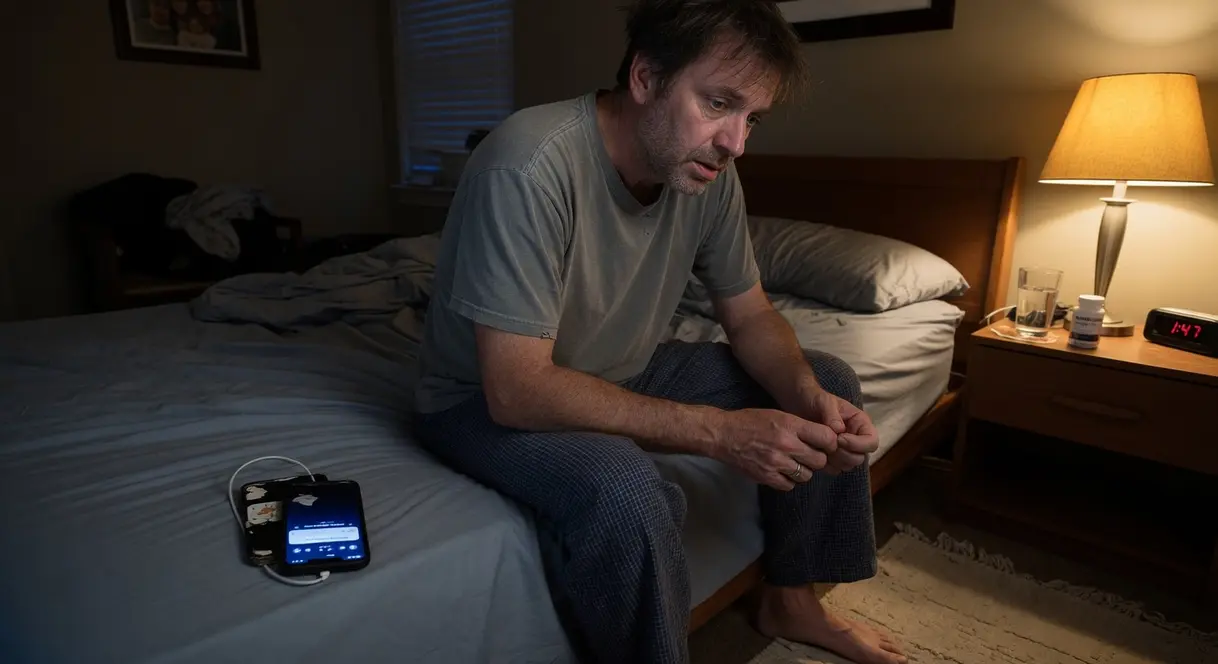
It’s 1:47 a.m. Your eyes burn, your shoulders ache, and you’ve been yawning since dinner — yet the moment your head hits the pillow, your brain flips on like someone hit a switch. You start replaying a conversation from three days ago. You wonder if you remembered to send that email. You check the clock again. Now it’s 2:03.
If you can’t sleep even though exhausted, you’re running into one of the more frustrating paradoxes in human physiology: fatigue and sleepiness aren’t the same thing, and the body has more than one way to keep you awake. Being tired but unable to fall asleep usually isn’t a willpower problem. It’s a signaling problem.
Tired vs. sleepy: they’re not the same signal
Fatigue is a whole-body sense of depletion — heavy limbs, low motivation, dry eyes, slow thinking. Sleepiness is something more specific: the biological drive to fall asleep, controlled mainly by two systems working in tandem.
The first is sleep pressure, driven by a molecule called adenosine that builds up in the brain the longer you’re awake. The second is your circadian rhythm, the roughly 24-hour internal clock that tells your body when it’s time to wind down and when it’s time to be alert. When these two systems line up, sleep comes easily. When they don’t — or when something else is overriding them — you can feel physically tired but mentally awake for hours.
That mismatch explains a lot. You can be exhausted from a long day and still be biologically wired for alertness because your circadian system hasn’t shifted into evening mode yet, or because stress hormones are drowning out the sleep signal.
The cortisol problem: why exhausted but wired at night is so common
Cortisol is the body’s main stress hormone, and it follows a daily rhythm. Levels are supposed to be highest in the morning (to help you get out of bed) and lowest in the late evening (to let melatonin take over). Chronic stress, irregular schedules, late-night screen use, and even skipped meals can flatten or shift that curve, leaving cortisol elevated at exactly the wrong time.
Elevated nighttime cortisol does two things that sabotage sleep. It raises heart rate and core body temperature slightly, which works against the natural cool-down sleep requires. And it primes the brain for vigilance — useful if there’s an actual threat, less useful when the only threat is tomorrow’s meeting.
This is the classic “exhausted but wired at night” experience. The body is physically depleted but neurochemically braced for action.
Hyperarousal: when the nervous system won’t stand down
Sleep researchers use the term hyperarousal to describe a state in which the nervous system, brain, and stress response are running hotter than they should be at rest. People with chronic insomnia often show signs of hyperarousal even during the day — higher resting heart rate, elevated metabolic activity, more brain activity on imaging studies.
What hyperarousal feels like in practice: your body is tired, but your thoughts won’t slow down. You notice every creak in the house. You feel a small jolt of adrenaline every time you check the clock. Trying harder to sleep makes it worse, because effort itself is arousing.
This is why advice like “just relax” tends to backfire. You can’t muscle your way into sleep. The state required is the opposite of effort.
More Helpful Reads You Might Like:
- 7 Subtle Signs Low Vitamin D Is Affecting Your Mood and Energy
- 7 Subtle Signs of Burnout You Might Be Ignoring
- How Sleep Affects Testosterone: What the Research Shows
Overtiredness: the counterintuitive reason you might be too tired to sleep
Parents of toddlers know this one. Push a child past their sleep window and instead of crashing, they get a second wind — hyperactive, emotional, impossible to settle. The same thing happens to adults, just with less obvious behavior.
When you stay awake significantly past your usual bedtime, your body interprets the prolonged wakefulness as a signal that something important must be happening. Cortisol and adrenaline rise to keep you going. By the time you finally try to sleep, the stress response is in full swing, and the sleep window has closed.
This is one reason “I’ll just push through until I’m really tired” often produces the opposite of the intended result. Being too tired to sleep is a real physiological state, not just a figure of speech.
What’s keeping the brain awake when the body is done
Several specific patterns show up again and again in people who feel fatigue but unable to sleep:
- Evening light exposure. Bright light, especially the blue-enriched light from phones and laptops, suppresses melatonin and delays the circadian shift toward sleep.
- Late caffeine. Caffeine has a half-life of roughly five to six hours, meaning a 3 p.m. coffee can still have a meaningful amount in your system at 11 p.m.
- Alcohol. It may help you fall asleep faster, but it fragments sleep later in the night and can cause middle-of-the-night wake-ups with a racing heart.
- Irregular bedtimes. The circadian system runs on consistency. Shifting your sleep window by even an hour or two on weekends can leave you tired but unable to fall asleep when Monday arrives.
- Rumination. Lying in bed reviewing problems trains the brain to associate the bed with mental activity rather than rest.
- Underlying conditions. Anxiety disorders, depression, thyroid issues, restless legs syndrome, sleep apnea, and chronic pain can all produce the physically tired but mentally awake pattern.
Practical steps that actually help
Build a buffer between the day and the bed
The hour before sleep is doing more work than most people realize. Dim the lights. Get off bright screens, or at least turn brightness down dramatically. Lower the thermostat — a cool room (around 65–68°F for most adults) helps the core body temperature drop, which is part of how sleep is initiated.
Get out of bed if you’re not sleeping
This is one of the most evidence-supported behavioral techniques for insomnia, and it feels wrong every time. If you’ve been lying awake for roughly 20 minutes, get up. Go to another room. Do something quiet and boring under low light — read something dull, fold laundry — until you feel genuinely sleepy, then return to bed. The point is to stop pairing the bed with wakefulness and frustration.
Address the wired feeling directly
Slow nasal breathing — inhaling for four counts and exhaling for six or eight — activates the parasympathetic nervous system, the body’s “rest and digest” branch. A warm shower or bath about 90 minutes before bed can paradoxically help cool the body’s core temperature afterward, which supports sleep onset.
Stop chasing sleep with effort
Paradoxical intention — giving up on trying to fall asleep and instead lying quietly with the goal of just resting — sometimes works better than any technique. The brain stops treating sleep as a performance.
Anchor your wake time
The single most powerful lever for resetting a confused circadian system is a consistent wake time, even after a rough night. Morning light exposure within the first hour of waking reinforces the rhythm. Bedtime will gradually follow.
Be careful with naps and sleep aids
Long late-afternoon naps lower the sleep pressure you need for nighttime. Over-the-counter sleep aids containing diphenhydramine can leave a hangover effect and aren’t recommended for regular use, particularly in older adults. Melatonin, used in low doses (often 0.3–1 mg) a few hours before the desired bedtime, is more useful as a circadian signal than a sedative.
When to talk to a clinician
Occasional rough nights are part of being human. Persistent trouble is worth a conversation with a healthcare provider, especially if any of the following apply:
- Trouble falling or staying asleep at least three nights a week for three months or longer
- Loud snoring, gasping, or breathing pauses noticed by a partner
- Daytime sleepiness severe enough to affect driving, work, or safety
- Significant anxiety or low mood accompanying the sleep problem
- Restless, crawling sensations in the legs at night
- Sleep problems that began with a new medication
Cognitive behavioral therapy for insomnia (CBT-I) is considered the first-line treatment for chronic insomnia and tends to outperform sleep medications over the long run. It’s available through specialty clinics, some primary care settings, and validated digital programs.
Why you can’t sleep even though exhausted — and what to do tonight
The short version: exhaustion isn’t sleepiness, and the systems that drive sleep can be overridden by stress hormones, a misaligned body clock, or a nervous system stuck in high alert. Pushing harder rarely fixes it. What helps is lowering the stimulation, keeping wake times steady, getting out of bed when you’re not actually sleeping, and treating the bed as a place for rest rather than problem-solving.
If tonight is already a tough one, the most useful move is often the least intuitive: stop trying to fall asleep, get up briefly, dim the lights, and let the body settle on its own terms. Sleep tends to arrive when you stop chasing it.
Medical Disclaimer: This content is for educational purposes only and does not replace professional medical advice, diagnosis, or treatment. Always consult your physician or a qualified healthcare provider with any questions about a medical condition.
Sources & Further Reading
- PMC/NIH: Insomnia Severity is Associated with Morning Cortisol and Psychological Health
- PMC/NIH: Hyperarousal and Sleep Reactivity in Insomnia: Current Insights
- PubMed: Hyperarousal in Insomnia Disorder: Current Evidence and Potential Mechanisms
- PMC/NIH: Adenosine, Caffeine, and Sleep-Wake Regulation: State of the Science and Perspectives
- Mayo Clinic: Insomnia Treatment – Cognitive Behavioral Therapy Instead of Sleeping Pills