 Written by
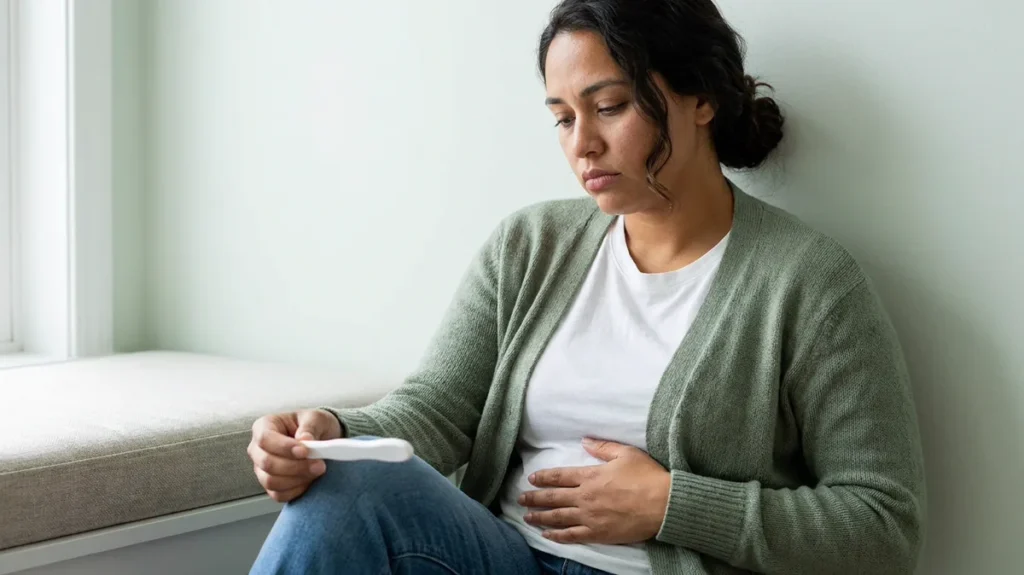
Sore breasts, cramps and a wave of tiredness before your period can mean it’s on its way, or that you’re pregnant, and your body usually won’t say which yet. In both cases progesterone is high, and it’s the hormone behind the tender breasts and bloating of PMS. Your ovary makes it every cycle after you ovulate, and it stays high if you’re pregnant, so early pregnancy can bring on the very same feelings. What you can pin down is when a test will pick up a pregnancy, and what a negative result really means.
Quick answer: Before a missed period, symptoms can’t reliably tell you whether it’s PMS or early pregnancy, because the same hormone, progesterone, is high in both. A home pregnancy test is what settles it, but timing matters: on the day your period is due, about 1 in 10 pregnancies can’t show up on any test yet. If it’s negative and your period still hasn’t come, test again a few days later with first-morning urine.
In this article
Why do PMS and early pregnancy feel so alike?
The week or two before a period is genuinely hard to read. If you’ve been pressing on your breasts to see if they’re still sore and second-guessing every twinge, you aren’t missing some obvious clue. The physical symptoms doctors look for when they diagnose PMS include sore breasts, bloating, headache and achy muscles or joints. Those are the very ones that show up on every list of early pregnancy signs. About 8 in 10 women notice at least one symptom before their period, so noticing changes that week is completely normal.
The one thing only pregnancy makes is hCG, the hormone home pregnancy tests look for. Your body starts making it only after implantation, when the early embryo settles into the lining of the uterus, usually about 8 to 10 days after ovulation. Before then, there’s nothing for a test to find.
Which signs point more toward pregnancy than PMS?
It isn’t the most exciting answer, but the calendar is a better guide than any single symptom. PMS keeps a tight schedule: it shows up in the days before your period and fades within about 4 days after bleeding starts. Pregnancy symptoms don’t fade on that schedule, because there’s no real period to end them.
The missed period itself is the strongest sign. Nausea, the symptom most people link with pregnancy, usually starts around the time of the missed period or after it, rather than before. So if your period is due Friday and you felt queasy on Tuesday, that’s a weak clue either way. Tiredness, peeing more often, suddenly not being able to stand certain foods and mood swings all get listed as early pregnancy signs. Before a missed period, they overlap too much with PMS to point either way.
| Clue | Points to PMS | Points to early pregnancy |
|---|---|---|
| When symptoms start | In the days before your period | Can start at the same time; the clearer signs come after a missed period |
| Once bleeding starts | Symptoms fade within about 4 days | No true period arrives |
| Sore breasts, bloating, cramps | Common | Common |
| Nausea | A weak clue days before your period | Usually begins around or after the missed period |
| Home pregnancy test | Negative, once enough time has passed | Positive, though it can read negative if taken too early |
Is spotting before your period implantation bleeding?
Implantation bleeding is the idea that a little spotting when the embryo settles in, about a week before your period, is an early sign of pregnancy. You’ll see it on almost every pregnancy site, but there’s surprisingly little evidence behind it.
Few studies have tracked this day by day. In one that did, women trying to get pregnant kept daily bleeding diaries, and any bleeding in early pregnancy tended to show up around the time their period was due. Only one woman bled on the day her embryo implanted. The study was small and relied on what women wrote down, so it can’t prove implantation bleeding never happens. It does mean spotting a week early can’t confirm a pregnancy, whatever its color, and there’s no reliable way to tell it from a light period.
If you do turn out to be pregnant, light bleeding early on is usually harmless. In that same study, most of the women who bled went on to have a baby. Bleeding that comes with pain on one side of the lower belly is another story, because that combination means seeing a doctor the same day.
When can a home pregnancy test give you a real answer?
The earliest test worth taking is on the day your period is due. That’s frustrating when you want to know today. It comes down to how the test works.
A home test is like a rain gauge with a line drawn on it. It only says yes once enough hCG has collected in your urine to reach that line, so an early test can look empty after the rain has already started. Two things make it tricky: the rain can’t start until implantation, which can vary by several days, and every brand draws its line at a different height.
On the day your period is due, about 1 in 10 pregnancies haven’t implanted yet, so no test can pick them up. A week later, nearly all of them can be detected. Store-bought tests can miss even more on that first day. An older lab study found most of them couldn’t pick up the low level of hormone that’s there when a period is due.
Two habits help. Use the first urine of the morning, which is more concentrated, so a small amount of hormone is more likely to reach the line. Read the result within the time window on the instructions, since accuracy depends on following them. If your cycles are irregular, the day your period is due is a moving target, so an early negative means even less.
What if the test is negative and your period still hasn’t come?
A negative result isn’t final, and testing too early is the most common reason it’s wrong, according to the FDA’s guidance on home pregnancy tests. If you’re still waiting on your period, take another test several days later, using the first urine of the morning. The most reliable result comes 1 to 2 weeks after the missed period. If your period was due Monday and that morning’s test was negative, test again by the weekend. Waiting those few days is miserable, but a test taken then is one you can actually believe.
If your period shows up and the symptoms fade within a few days, that pattern fits PMS. When it happens every month and gets in the way of your life, doctors confirm PMS with a simple daily symptom log kept for 2 cycles. It’s easy to misremember when symptoms started, and a log takes the guesswork out.
If tests stay negative and you still haven’t had a period after 3 months, it’s time to make an appointment with your doctor. If your cycles are usually irregular, you can give it 6 months. They’ll confirm you’re not pregnant first, then look for hormonal causes, such as a thyroid problem.
What if the test is positive?
If the test is positive and you feel fine, that’s your cue to call your doctor’s office and set up your first prenatal visit. Pain on one side of the lower belly is different: with a positive test, or while a pregnancy is still possible, it needs same-day care. That goes double if there’s any bleeding with the pain, even bleeding that looks like a normal period. Heavy bleeding after a positive test also means getting seen that day. Pain at the top of your shoulder, fainting or feeling like you’re about to faint calls for emergency care.
These can be signs of an ectopic pregnancy, one that’s growing outside the uterus, usually in a fallopian tube. It happens in about 1 to 2 of every 100 pregnancies. It can happen to anyone, too: about half of women who have one had no obvious reason to expect it. If you get a positive test with an IUD in place, call your doctor right away, even without pain, because those pregnancies are more often in the wrong place.
More Helpful Reads You Might Like:
- Irregular Periods After 40: When It’s Perimenopause and When It’s Something Else
- Worse PMS in Your 40s? It Might Be Perimenopause Talking
Frequently Asked Questions
Can you have PMS symptoms and still be pregnant?
Yes. Progesterone rises after ovulation every cycle and stays high in pregnancy, so sore breasts, bloating and cramps before a missed period fit either one. A pregnancy test taken once your period is late is what tells them apart.
How early can a pregnancy test detect pregnancy?
Not before the embryo implants, which usually happens 8 to 10 days after ovulation. The day your period is due is the earliest a test makes sense, and some pregnancies still won’t show then, so one taken a week later is far more dependable.
Are pregnancy cramps different from period cramps?
Not in a way you can count on early. The better clue is what happens next: PMS cramps ease within a few days once bleeding starts. With a positive or possible pregnancy, pain on one side of the lower belly needs to be checked that same day.
Is nausea before your period a sign of pregnancy?
On its own, it says very little. Morning sickness usually kicks in around the time a period is missed, or a bit later, so an upset stomach several days before your period should start isn’t good evidence of pregnancy.
Why is my period late if my pregnancy test is negative?
Often the test was taken too early, before enough pregnancy hormone had built up, so wait several days and retest, ideally with the first urine of the morning. If tests stay negative and no period comes for 3 months, or 6 with irregular cycles, make an appointment with your doctor.
Medical Disclaimer: This content is for educational purposes only and does not replace professional medical advice, diagnosis, or treatment. Always consult your physician or a qualified healthcare provider with any questions about a medical condition.
Sources & Further Reading
How we sourced this article: we rely on peer-reviewed studies, clinical guidelines and public-health agencies (CDC, NIH, AHA, WHO), check every link before publishing, and update articles when the evidence changes. Read our editorial approach.
- FDA: Home Use Tests – Pregnancy
- Wilcox AJ et al. Natural limits of pregnancy testing in relation to the expected menstrual period. JAMA 2001;286(14):1759-1761
- Harville EW, Wilcox AJ, Baird DD, Weinberg CR. Vaginal bleeding in very early pregnancy. Hum Reprod 2003;18(9):1944-1947
- Cole LA et al. Accuracy of home pregnancy tests at the time of missed menses. Am J Obstet Gynecol 2004;190(1):100-105
- Gadsby R et al. The onset of nausea and vomiting of pregnancy: a prospective cohort study. BMC Pregnancy Childbirth 2021
- Hofmeister S, Bodden S. Premenstrual Syndrome and Premenstrual Dysphoric Disorder. Am Fam Physician 2016;94(3):236-240
- Hendriks E, Rosenberg R, Prine L. Ectopic Pregnancy: Diagnosis and Management. Am Fam Physician 2020;101(10):599-606
- Klein DA, Paradise SL, Reeder RM. Amenorrhea: A Systematic Approach to Diagnosis and Management. Am Fam Physician 2019;100(1):39-48
- MedlinePlus: Pregnancy test
- Modzelewski S et al. Premenstrual syndrome: new insights into etiology and review of treatment methods. Front Psychiatry 2024