 Written by
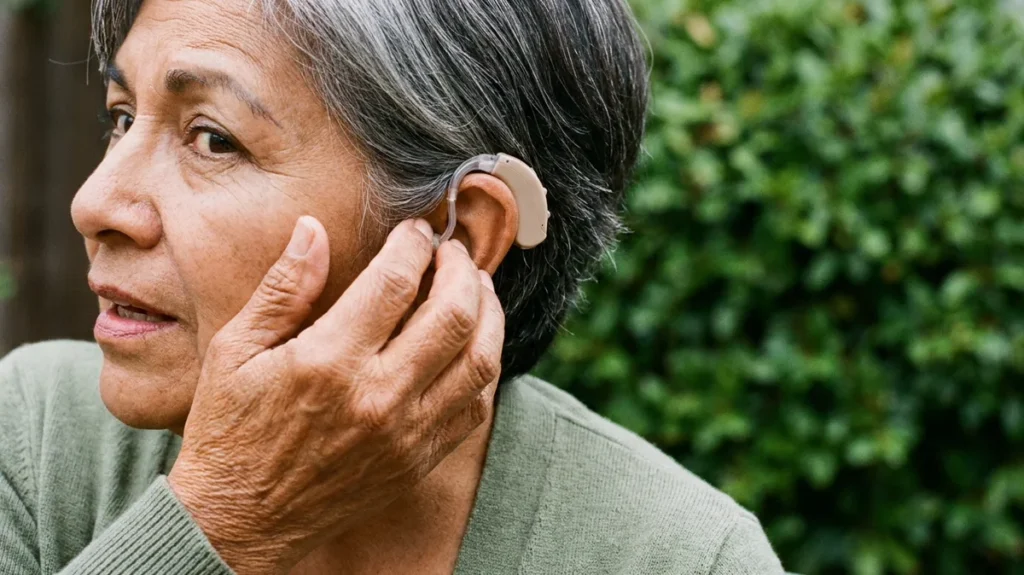
Turning the TV up a notch, or nodding along at a noisy dinner without catching the joke, is how hearing loss tends to show up. Often it’s a spouse or a grown kid who mentions it first. Age-related hearing loss creeps in as tiny hair cells in the inner ear wear out, starting with high pitches, so people seem to mumble even at a normal volume. Since 2022, adults have been able to buy hearing aids off the shelf with no exam, which leaves one question: is a drugstore pair enough, or should a hearing test come first?
Quick answer: Signs you need hearing aids include trouble following speech in noisy places, struggling on the phone, feeling worn out from listening, and family saying the TV is too loud. Over-the-counter aids are designed for adults with these signs, no test required. See a doctor first if the label’s warning signs apply: one-sided loss or ringing, ear pain or drainage, sudden hearing change, or severe dizziness.
In this article
What are the signs you need hearing aids?
Over-the-counter (OTC) hearing aids come with an FDA label that lists the everyday signs of mild to moderate hearing loss. The label puts them in plain terms:
- Speech is hard to follow in noisy places, like a restaurant, or in a group.
- Phone calls are harder to hear than they used to be.
- Listening leaves you tired.
- Other people say your TV or radio is too loud.
Hearing loss comes on so gradually that the person who has it is often the last to notice. The family, meanwhile, has been reaching for the remote for months. When someone you live with mentions the TV volume more than once, take it as a real clue about your hearing.
In a large trial of 977 adults aged 70 to 84 with untreated hearing loss, hearing aids didn’t slow the decline in memory and thinking over 3 years. Only a smaller, higher-risk group in the study declined more slowly, and that finding came from an additional analysis of the trial data, so it’s less certain than the main result.
This kind of hearing loss is common, and it mostly goes untreated. More than 1 in 2 Americans 75 and older have hearing loss serious enough that hearing aids could help. Yet fewer than 1 in 3 adults over 70 who could benefit have ever used them, according to the National Institutes of Health.
Are OTC hearing aids made for your kind of hearing loss?
Probably, if your trouble shows up mostly in noisy places, in groups or on the phone. That’s the person who does fine one-on-one in a quiet kitchen but feels lost at a crowded family dinner. The most useful line on the box compares noisy rooms with quiet ones. If you can’t follow speech even in a quiet room, or loud sounds like music, power tools or engines seem faint, the label sends you to a hearing professional. That pattern suggests more than mild to moderate loss.
The FDA’s rule covers adults 18 and older with perceived mild to moderate hearing loss, and anyone younger needs a prescription aid. In that sense, OTC aids work a lot like drugstore reading glasses, made for a common problem that adults can usually judge for themselves.
The word “perceived” is there on purpose. The FDA chose not to set a decibel cutoff, partly because two people with the same test results can struggle in very different ways.
Reading glasses don’t come in a strength for serious vision problems, and OTC aids have a similar limit. A built-in cap on how loud they can get is part of why they aren’t meant for severe loss.
The label also lists signs that mean you should see a doctor, preferably an ear, nose and throat specialist, before using any OTC aid:
- An ear that’s misshapen or injured.
- Blood, pus or fluid draining from the ear in the past 6 months.
- Ear pain or discomfort.
- Heavy earwax, or something stuck in the ear.
- Severe dizziness or vertigo.
- A sudden change in hearing in the past 6 months.
- Hearing that gets worse and then better again.
- Worse hearing or ringing in only one ear.
These are reasons to have the ear itself checked first, since a hearing aid only makes sound louder and can’t treat whatever is causing them.
Do you need a hearing test before buying OTC hearing aids?
No. The law lets you buy OTC aids without seeing anyone, and if you do get tested, you can take your results and buy the device wherever you like. The U.S. Preventive Services Task Force says there isn’t enough evidence to recommend for or against screening adults 50 and older who have no symptoms. That doesn’t apply if you’ve already noticed a problem. Even so, a test is worth considering, because it tells you two things the box can’t: how much hearing you’ve lost, and whether one ear is worse than the other.
Hearing checks come in a few kinds:
- A full hearing test in a sound booth, done by an audiologist or an ENT. It measures how loud sounds have to be before you hear them, one ear at a time, and it’s the standard other checks are measured against.
- A screening at a regular checkup, which can flag a possible problem that a booth test then confirms.
- A self-test on a computer or phone, where you pick out spoken numbers over background noise. In a small study, this kind of test did a good job of telling normal hearing from mild to moderate loss, but it can’t say how much loss you have.
A normal self-test doesn’t settle things if you’re still missing half the conversation at dinner. In that case, what happens at the table counts for more than the score, and a booth test is the next step.
How well do OTC hearing aids work compared with an audiologist’s fitting?
Better than many people expect, at least in the short run. In a U.S. trial, adults aged 55 to 79 with mild to moderate loss were randomly assigned to one of three groups. Some got aids fitted by an audiologist, and some picked and set up their own the way an OTC buyer would. A third group got aids set up as a placebo, so they weren’t expected to help. That gave the other two groups something to be measured against. Both groups with real settings were helped, and the people who set up their own aids did only a little worse. Where they fell behind was in how happy they were: fewer people in that group said they’d probably buy their aids once the trial ended.
A smaller trial in South Africa found much the same, though the device maker paid for it and it tested just one model. Both trials lasted only about 6 weeks, and everyone in them had mild to moderate loss and could handle the setup on their own. Nobody knows yet how well OTC aids hold up over years of everyday use.
Unlike reading glasses, hearing aids don’t work at their best the moment you put them on. In the South African trial, people’s impressions kept shifting between the second and sixth week, so judging a pair after 3 days doesn’t give it a fair shot. The FDA requires the box to state the return policy, and reading it first tells you how long you have to decide.
| What’s known | OTC hearing aids | Prescription hearing aids |
|---|---|---|
| Who can use them | Adults 18 and older | Any age, including children and teens |
| Hearing loss they’re made for | Perceived mild to moderate | Any degree, mild to profound |
| Need a hearing professional to buy | No | Yes, sold only through a licensed hearing professional, who programs them to your hearing |
| Who sets them up | You, with an app or controls | An audiologist or other licensed professional |
| How loud they can get | Capped by federal rule | Not limited by the OTC cap |
| Benefit in short trials of mild to moderate loss | Close to an audiologist’s fitting | The standard the trials compared against |
| Likely to buy after 6 weeks (one U.S. trial of 154 adults, 2017) | A little over 1 in 2 (people who picked and set up their own) | About 4 in 5 (fitted by an audiologist) |
What if OTC hearing aids don’t help after a fair trial?
It’s disappointing when a few weeks of daily use don’t change much, but that result still tells you something. The loss may be more than mild to moderate, or it may call for a prescription aid that a professional fits and adjusts. A hearing test sorts out which.
When you go in, be ready to describe the signs that sent you looking for hearing aids in the first place:
- Where your hearing lets you down: noisy rooms, phone calls, or quiet conversations too.
- Whether one ear seems worse, or rings when the other doesn’t.
- What the OTC aids helped with, and what they didn’t.
From there, the audiologist or doctor measures your hearing. If prescription aids turn out to be the better fit, they’ll set them up and fine-tune them over follow-up visits, the part OTC aids leave up to you.
More Helpful Reads You Might Like:
- Forgetful or Something More? How to Tell Normal Aging From Dementia
- Are Your Headphones Hurting Your Hearing? What You Need to Know
Frequently Asked Questions
At what level of hearing loss do you need hearing aids?
Hearing is normal when you can pick up sounds softer than 20 decibels, and 20 to 34 decibels is mild loss. At 35 or more in the better ear, adults can generally benefit from hearing aids. OTC aids are made for mild to moderate loss, so people with mild loss can use them too.
How do I know if I need hearing aids?
Most people first notice trouble in noisy restaurants, on phone calls or in groups, feel worn out after a long conversation, or hear from family that the TV is too loud. Struggling even in a quiet room means a hearing test with an audiologist comes first.
Can an online hearing test tell if I need hearing aids?
It can raise a flag. Phone and computer tests that play numbers over background noise are good at sorting normal hearing from mild to moderate loss, but they can’t tell you how much hearing you’ve lost. If conversations still slip past you, book a booth test with an audiologist.
Who shouldn’t use over-the-counter hearing aids?
Anyone under 18, anyone who can’t follow speech even in a quiet room, and anyone with a warning sign from the label, such as one-sided hearing loss or ringing, ear pain or drainage, a sudden hearing change, or severe dizziness. Those people should see a doctor first.
How long does it take to get used to hearing aids?
Give new aids several weeks of daily wear before you judge them. In one trial, people’s opinions of their aids kept changing between week 2 and week 6, so a first impression after a few days doesn’t tell you much. Check the return window on the box before you start.
Medical Disclaimer: This content is for educational purposes only and does not replace professional medical advice, diagnosis, or treatment. Always consult your physician or a qualified healthcare provider with any questions about a medical condition.
Sources & Further Reading
How we sourced this article: we rely on peer-reviewed studies, clinical guidelines and public-health agencies (CDC, NIH, AHA, WHO), check every link before publishing, and update articles when the evidence changes. Read our editorial approach.
- FDA: OTC Hearing Aids: What You Should Know
- Federal Register: Medical Devices; Ear, Nose, and Throat Devices; Establishing Over-the-Counter Hearing Aids (Final Rule)
- NIDCD: Quick Statistics About Hearing, Balance, & Dizziness
- De Sousa KC et al. Effectiveness of an Over-the-Counter Self-fitting Hearing Aid Compared With an Audiologist-Fitted Hearing Aid: A Randomized Clinical Trial. JAMA Otolaryngol Head Neck Surg
- Humes LE et al. The Effects of Service-Delivery Model and Purchase Price on Hearing-Aid Outcomes in Older Adults: A Randomized Double-Blind Placebo-Controlled Clinical Trial. Am J Audiol
- USPSTF: Hearing Loss in Older Adults: Screening
- Validation of a Computer-Administered Version of the Digits-in-Noise Test for Hearing Screening in the United States. J Am Acad Audiol
- Lin FR et al. Hearing intervention versus health education control to reduce cognitive decline in older adults with hearing loss in the USA (ACHIEVE): a multicentre, randomised controlled trial. Lancet
- German-language consensus on the WHO grades of hearing loss (HNO)
- MedlinePlus: Age-related hearing loss