 Written by
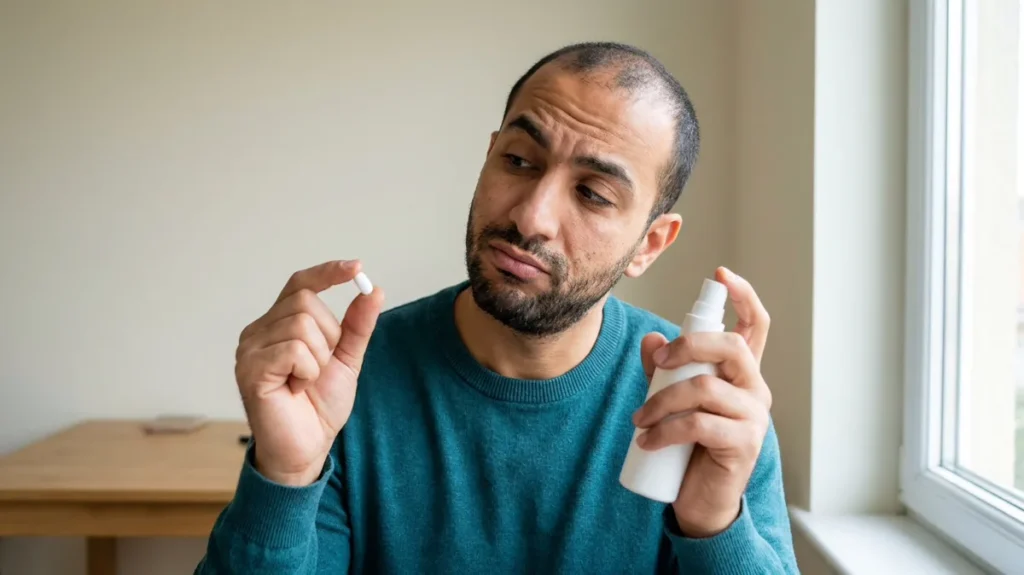
Finasteride pills have a reputation for sexual side effects, so the spray-on version in all those telehealth ads sounds like a tidy workaround. Both forms go after DHT, a hormone your body makes from testosterone. Over time, DHT shrinks the follicles on top of the head, so each new hair grows back thinner and shorter. Finasteride blocks the enzyme that turns testosterone into DHT. What you probably want to know is whether the spray keeps that benefit for your hair while leaving the rest of your body alone.
Quick answer: In the main trial of topical and oral finasteride, a manufactured spray sold in Europe grew about as much hair as the pill in 6 months. Far less drug reached the blood, but blood DHT still dropped by about a third, so side effects aren’t ruled out. No finasteride spray is FDA-approved in the U.S.; the ones sold here are mixed to order by pharmacies, without FDA review.
In this article
What are the finasteride pill and the finasteride spray?
The pill is finasteride 1 mg (Propecia), which the FDA has approved for male pattern hair loss in men only.
The spray is a different story in the U.S. No topical finasteride has FDA approval, so what telehealth companies sell is compounded. That means a pharmacy mixes it to order, and the FDA hasn’t checked its strength, quality or safety. Two sprays from two companies may not contain the same thing. A manufactured spray is approved in some European countries, and that’s the product the main trial tested. If you assumed the spray in those ads was simply a gentler, approved cousin of the pill, you’re in good company, because the ads rarely spell out the difference. Both work like a dial on your DHT supply. The pill turns it down everywhere, and the spray is meant to turn it down mostly where your hair is.
Does the spray still get into your bloodstream?
Yes, though far less of it. In the 6-month European trial, men using the spray had only a tiny fraction of the finasteride in their blood that the pill produced. At its peak, the level was more than 100 times lower. That’s the fact the ads lean on, and it’s real.
What matters more is what that small amount still does. After 6 months, blood DHT had dropped by about a third in men on the spray and by just over half in men on the pill. The placebo spray didn’t change it. In other words, the spray turns the dial down across your whole body too, just not as far as the pill.
How far depends on how much you put on. In studies that tested different amounts, more solution meant more drug in the blood and a bigger drop in DHT. In one small, week-long study, the spray used twice a day lowered blood DHT about as much as the pill did. It managed that even though far less of the drug reached the blood. That’s frustrating if you were hoping for a clean answer. Sprays compounded in the U.S. vary in strength and in what the finasteride is mixed into, and none of them has been tested for how much gets absorbed.
Does topical finasteride grow as much hair as the pill?
In the European trial, roughly. Researchers randomly assigned men ages 18 to 40 in Europe to the spray, the pill or a placebo spray. By the end, men on the spray had gained about 20 hairs in a small test patch of scalp, close to the pill’s 21 and well ahead of placebo’s 7.
Those results look like a tie, and sellers present them that way. The trial wasn’t built to show that, though. It compared each treatment with placebo rather than with each other, and the pill group was small. The spray it tested was also a manufactured European product, not one of the compounded sprays sold in the U.S.
Time is the other gap. The pill has kept hair loss in check in trials lasting 5 years, while the spray trial stopped at 6 months. If you’re hoping to keep your hairline for decades, nobody can tell you yet how the spray holds up over that many years.
| What’s known | Finasteride pill | Finasteride spray |
|---|---|---|
| FDA status in the U.S. | Approved for male pattern hair loss in men | Not approved; sold as a compounded product |
| Drop in blood DHT at 6 months | Just over half | About a third (European trial spray) |
| Hairs gained in a test patch at 6 months (placebo: about 7) | About 21 | About 20 |
| Longest trials | 5 years | 6 months |
| Sexual side effects in trials | About 1 to 2 in 100 men, vs about 1 in 100 on placebo | Similar to placebo in one 6-month trial; too few cases to compare |
| Extra caution | Pregnant women shouldn’t handle broken tablets | Greater risk of skin transfer to a partner |
| If you stop | Gains fade within 12 months | Not studied; expected to fade too, since it acts the same way |
Are the side effects really lower with the spray?
Start with the pill, because its reputation is bigger than its numbers. In the trials behind its FDA label, about 1 to 2 in 100 men on finasteride reported lower sex drive, erection problems or ejaculation problems. On placebo, it was about 1 in 100. The vast majority of men in those trials never reported any of these problems.
With the spray, the question is whether less drug in the blood means fewer side effects. In the 6-month trial, sexual side effects showed up about as often on the spray as on placebo. There were too few cases to compare the spray fairly with the pill, though. It may turn out to be easier on men than the pill, but no study has shown that yet.
The FDA has also issued a warning about compounded finasteride sprays specifically. Over five years, it received 32 reports of people having problems on these sprays: sexual trouble, anxiety, depression, suicidal thoughts, poor sleep and testicular pain. Most said the symptoms didn’t go away when they stopped. Some said their prescriber had told them the spray carried no risk. Thirty-two reports can’t tell anyone how common these problems are. They’re enough to put the “no risk” pitch to rest.
Mood is the side effect to take most seriously. European drug regulators confirmed suicidal thoughts as a side effect of finasteride tablets. Their review found no evidence tying the spray to suicidal thoughts, but the FDA’s spray reports above include them, so the same steps apply to either form:
- Low mood, depression or thoughts of suicide: Stop finasteride and contact your prescriber. If you’re in crisis, call or text 988.
- Sexual problems or testicular pain: Tell your prescriber, even if they seem minor, since some reports describe symptoms that lasted after stopping.
Finasteride in either form can harm a male fetus, which matters if your partner is or could become pregnant. The spray carries the greater risk here, because the FDA says it’s more likely to pass to a woman through skin contact. With the spray, the precautions are letting it dry and keeping your scalp from touching her skin. The tablets are coated, which is why the warning for the pill is about broken or crushed ones: women who are or may be pregnant shouldn’t handle those.
If you get PSA tests for prostate cancer screening, make sure whoever orders them knows you use finasteride. The pill lowers the result, and what the spray does to it hasn’t been studied.
How long do you have to keep using finasteride?
Finasteride holds hair loss back only as long as you keep using it. On the pill, the gains fade within 12 months of stopping. No study has followed people after they stop the spray, but since it works on the same hormone, there’s no reason to expect the gains to last without it. It’s a treatment you’d stay on for years, which is why the side-effect question matters so much.
If finasteride in any form makes you uneasy, it isn’t your only option. Topical minoxidil is also FDA-approved for male pattern hair loss, and it works without blocking DHT. Which treatment fits you is something to work out with your prescriber, and it’s fine to change course if the first choice doesn’t sit well with you. If a compounded spray comes up, it’s worth asking what’s in it: the finasteride strength, how much you’d apply each day and whether minoxidil is mixed in. Blood levels rise with the amount, so those details matter.
Changes take at least 3 months of daily use to show, so you and your prescriber will usually judge how it’s working over a longer stretch than that. A photo of your crown before you start makes that comparison easier. The wait tends to pay off: in the pill’s label trials, most men taking it had no further hair loss over 2 years, while most men on placebo kept losing ground.
More Helpful Reads You Might Like:
- Clascoterone for Hair Loss: Does the 539% Result Hold Up?
- Clascoterone vs Minoxidil: Should You Switch or Use Both?
- Hair Thinning at 30? Here’s What’s Actually Happening — and What Helps
- Oral Minoxidil 2.5 mg vs 5 mg: Does Doubling the Dose Grow More Hair?
Frequently Asked Questions
Is topical finasteride FDA-approved?
No. The FDA hasn’t approved any finasteride spray or solution, so the versions sold in the U.S. are compounded: a pharmacy mixes them to order without FDA review of their strength or quality. Only the 1 mg pill (Propecia) is approved for male pattern hair loss.
Can topical finasteride still cause side effects?
Yes. Less of the drug reaches your blood, but in the European trial blood DHT still fell by about a third, so the effect isn’t limited to the scalp. The FDA has also received reports of sexual problems, depression and testicular pain from people using compounded sprays.
Can you switch from oral to topical finasteride?
That’s your prescriber’s call. The trial that compared the two tested a European spray, not the compounded versions sold in the U.S. Because finasteride’s benefit fades once it’s stopped, a gap in treatment or a weaker product can mean lost ground over the following months.
Can topical finasteride affect my partner?
It can. The FDA warns that the spray is more likely than the coated pill to pass to women through skin contact, which matters if a partner is or could become pregnant. Letting it dry and avoiding scalp contact are the usual precautions.
Medical Disclaimer: This content is for educational purposes only and does not replace professional medical advice, diagnosis, or treatment. Always consult your physician or a qualified healthcare provider with any questions about a medical condition.
Sources & Further Reading
How we sourced this article: we rely on peer-reviewed studies, clinical guidelines and public-health agencies (CDC, NIH, AHA, WHO), check every link before publishing, and update articles when the evidence changes. Read our editorial approach.
- Piraccini BM et al.: Efficacy and safety of topical finasteride spray solution for male androgenetic alopecia: a phase III, randomized, controlled clinical trial (JEADV)
- FDA: FDA alerts health care providers, compounders and consumers of potential risks associated with compounded topical finasteride products
- FDA label: PROPECIA (finasteride) tablets 1 mg, prescribing information (Organon), FDALabel
- Lee SW et al.: A Systematic Review of Topical Finasteride in the Treatment of Androgenetic Alopecia in Men and Women (J Drugs Dermatol)
- Caserini M et al.: A novel finasteride 0.25% topical solution for androgenetic alopecia: pharmacokinetics and effects on plasma androgen levels in healthy male volunteers (Int J Clin Pharmacol Ther)
- Gupta AK et al.: Relative Efficacy of Minoxidil and the 5-alpha Reductase Inhibitors in Androgenetic Alopecia Treatment of Male Patients: A Network Meta-analysis (JAMA Dermatology)
- European Medicines Agency: Finasteride- and dutasteride-containing medicinal products, referral
- Gupta AK et al.: Finasteride for hair loss: a review (J Dermatol Treat)
- MedlinePlus Genetics: Androgenetic alopecia