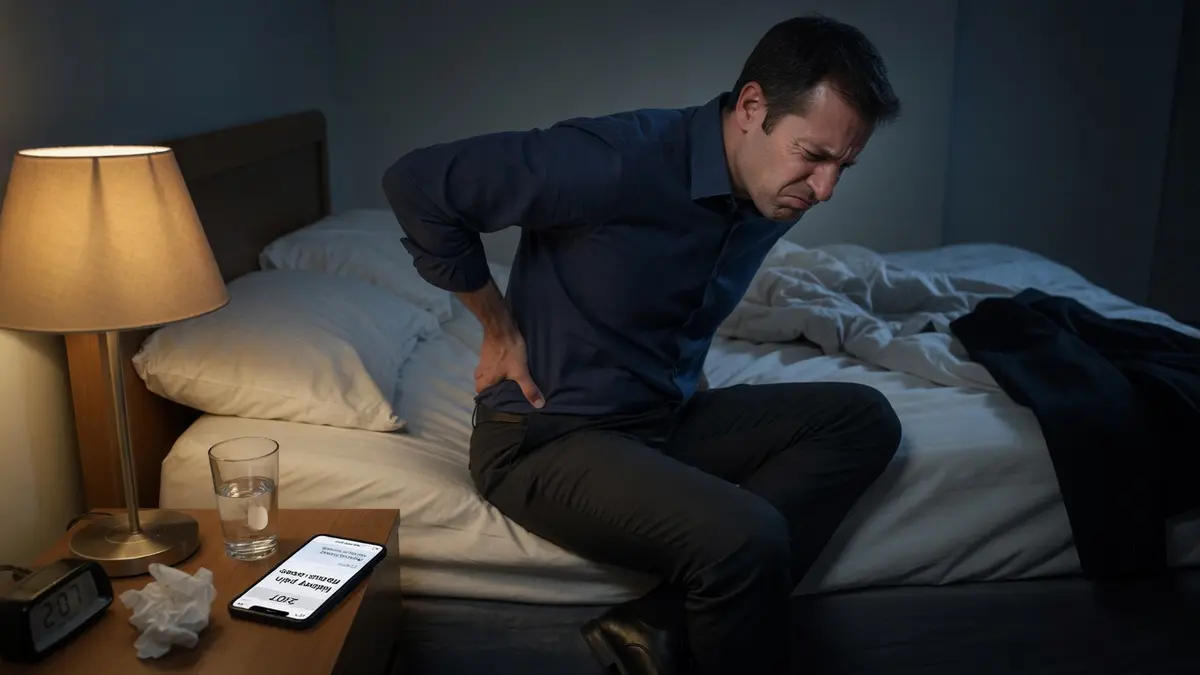
It usually starts in the back, just below the ribs, on one side. Not a dull ache you can ignore, but a deep, twisting pain that builds in waves and makes it impossible to sit still. Some people pace. Some can’t find a single position that helps. That restlessness — the inability to lie quietly the way you might with a pulled muscle — is one of the clues that something specific is happening inside the urinary tract.
So what does a kidney stone feel like, exactly? The honest answer is that it’s one of the more recognizable pains in medicine once you’ve felt it, but it can absolutely masquerade as other things at first. Knowing the pattern — where it starts, how it moves, what comes along with it — can help you figure out whether you’re dealing with a stone or something else entirely.
What does a kidney stone feel like when it’s actually moving?
A kidney stone is a hard mineral deposit that forms inside the kidney. Tiny ones can pass without you ever noticing. The pain shows up when a stone moves into the ureter — the narrow tube connecting the kidney to the bladder — and gets stuck or scrapes along the way. That tube is thin, and the body responds by squeezing to push the stone along. Those squeezes are what create the signature wave-like pain doctors call renal colic.
People describe it in remarkably consistent ways:
- Sharp, cramping pain that comes in surges rather than staying steady
- Pain that starts in the flank or back and radiates toward the lower belly and groin
- An intensity that ramps up over minutes, sometimes peaking severely enough that people feel nauseated or vomit
- Restlessness — a strong urge to move, stretch, or pace because no position brings relief
That last point matters more than it sounds. With many kinds of abdominal pain, people instinctively lie very still because movement makes it worse. Stone pain often does the opposite. The urge to keep shifting around is a meaningful detail to mention if you call your doctor.
Kidney stone pain location and how it travels
The location often shifts as the stone moves. Early on, when the stone is high near the kidney, the pain tends to sit in the flank — that area between your lower ribs and hip on one side. As the stone travels down toward the bladder, the pain may migrate forward and downward, into the lower abdomen and sometimes the groin or genitals. Men sometimes feel it in the testicle on the same side; women may feel it toward the labia.
It’s almost always one-sided. Pain that’s squarely in the center of your belly, or evenly across both sides, points away from a single stone and toward something else.
More Helpful Reads You Might Like:
- How to Prevent Kidney Stones: 7 Proven Strategies That Work
- Foamy Urine: 7 Common Causes and When to Worry
- Borderline vs Bipolar: How to Tell the Difference
Kidney stone symptoms beyond the pain
Pain is the headline, but it rarely shows up alone. A few other kidney stone symptoms tend to travel with it, and they can help confirm what’s going on.
- Changes in urination. Blood in the urine is common — it may look pink, red, or brownish, or it might only show up on a lab test. Some people feel a frequent, urgent need to pee, or burning, especially once the stone is close to the bladder.
- Nausea and vomiting. The kidneys and the gut share nerve pathways, so intense stone pain often triggers a queasy stomach.
- Sweating and inability to get comfortable. The pain can be severe enough to cause a cold sweat or a racing heart.
One thing a stone alone usually does not cause is fever. If you have a fever and chills along with the pain, that combination raises concern for an infection behind a blockage — and that’s a situation that needs urgent attention rather than waiting it out.
Kidney stone pain vs. other pain: sorting it out
This is where things get genuinely tricky, because several conditions sit in the same neighborhood. Here’s how stone pain tends to differ from the usual suspects.
A urinary tract infection (UTI)
A UTI — an infection in the bladder or urinary tract — can cause burning urination, urgency, and lower pelvic discomfort, much like a stone near the bladder. The difference is usually intensity and movement. UTI discomfort is often a steady burning or pressure rather than crushing waves, and it doesn’t typically radiate from your back down to your groin. When a UTI climbs up to the kidney, though, it can cause flank pain and fever, and at that point the two can be hard to tell apart without testing.
Appendicitis
Appendicitis — inflammation of the appendix — classically causes pain that settles in the lower right abdomen and gets worse with movement, coughing, or pressing on the area. Unlike stone pain, people with appendicitis usually want to stay completely still. Appendicitis pain also tends to build steadily over hours rather than crashing in like a sudden wave, and it’s often accompanied by loss of appetite and a low-grade fever.
Muscle strain or back pain
A pulled muscle in the back can mimic the location of early stone pain, but it behaves differently. Muscular pain usually changes with how you move, twist, or press on the spot — you can often find the tender muscle with your fingers. Stone pain doesn’t ease when you find the right position, and you generally can’t pinpoint it by pressing. Muscle strain also doesn’t cause blood in the urine or nausea.
Gallbladder and other causes
Gallbladder attacks tend to land in the upper right abdomen and are often linked to fatty meals. In women, ovarian cysts and ectopic pregnancy can cause sudden one-sided lower abdominal pain that overlaps with stone symptoms. That overlap is exactly why sudden, severe, unexplained abdominal or flank pain deserves a medical evaluation rather than self-diagnosis.
How to tell if you have a kidney stone at home
You can’t confirm a stone without imaging — typically a CT scan or ultrasound — and a urine test. But a few questions can help you gauge how likely it is before you decide what to do:
- Did the pain come on suddenly and arrive in waves, on one side?
- Does it travel from your back or flank toward your lower belly or groin?
- Can you not get comfortable no matter how you position yourself?
- Is there any pink, red, or brown tint to your urine?
- Have you had a stone before? (Once you’ve had one, you’re more likely to form another.)
The more of these that line up, the more a stone moves up the list of possibilities. That said, lining up the pattern isn’t the same as a diagnosis, and some serious conditions are deliberately good at imitating it.
When to go to the ER for a kidney stone
Plenty of small stones pass at home with fluids, time, and pain control. But certain signs mean you shouldn’t wait. Seek emergency care if you have:
- Fever or chills along with the pain — this can signal an infected, blocked kidney, which can become serious quickly
- Pain so severe that you can’t keep down fluids or medication
- Persistent vomiting
- Little or no urine output, or a known single kidney
- Blood in the urine with significant pain
- Pain that’s new, severe, and you’ve never been evaluated for a stone before
That last point is worth taking seriously. Knowing when to go to the ER for a kidney stone is partly about ruling out the dangerous lookalikes — appendicitis, a tubal pregnancy, an aortic problem — that can’t be told apart from a stone based on how it feels alone.
If the pain is manageable, you have no fever, and you’re able to drink fluids and urinate, it’s reasonable to call your doctor and be seen promptly rather than rushing to the emergency room. Drinking water helps, and over-the-counter pain relievers can take the edge off, though anyone with kidney concerns should check before using NSAIDs like ibuprofen.
So what does a kidney stone feel like compared to everything else?
The clearest tells are the combination: sudden one-sided pain that comes in waves, travels from your flank toward your groin, won’t let you sit still, and often brings blood in the urine and nausea without a fever. When the pain is steady, midline, worse with movement, or paired with fever, the picture leans elsewhere — and that’s a reason to get checked rather than guess. Pain is information, not a diagnosis. A urine test and imaging are what turn a strong hunch into an answer.
Medical Disclaimer: This content is for educational purposes only and does not replace professional medical advice, diagnosis, or treatment. Always consult your physician or a qualified healthcare provider with any questions about a medical condition.
Sources & Further Reading
- Mayo Clinic: Kidney Stones – Symptoms and Causes
- NIDDK (NIH): Symptoms & Causes of Kidney Stones
- NIH StatPearls (NCBI Bookshelf): Acute Renal Colic
- NIH StatPearls (NCBI Bookshelf): Kidney Stone Emergencies – Differential Diagnosis of Renal Colic
- Urology Care Foundation: Kidney Stones – Symptoms, Diagnosis & Treatment