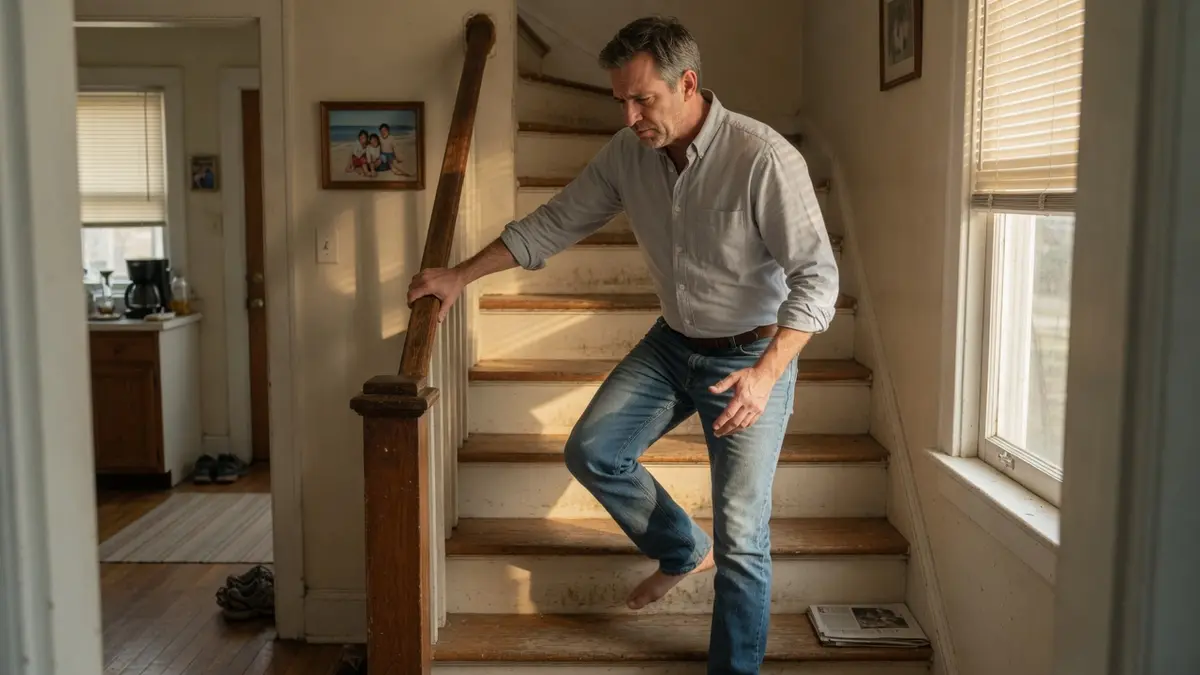
You head down a staircase, and right around the second or third step, a sharp or aching pain shows up at the front of your knee. Then you walk across the parking lot, the grocery store, your living room — and nothing. No pain at all. It’s an odd, frustrating mismatch, and it leaves a lot of people wondering whether something is actually wrong or whether they’re imagining it.
The pattern is real, and it has a logical explanation. Knee pain going down stairs while flat walking feels fine usually comes down to one thing: stairs ask far more of a specific part of your knee than level ground ever does. Understanding why helps explain what might be going on and what’s worth doing about it.
Why descending stairs is uniquely hard on your knees
Walking on flat ground is relatively gentle on the knee joint. Your leg stays fairly straight, the forces are spread out, and the muscles around the knee share the load without much strain.
Going down stairs changes the math entirely. Each step requires you to lower your full body weight onto a bent knee, and your quadriceps — the big muscles on the front of your thigh — have to contract while lengthening to control that descent. This is called an eccentric contraction, basically a controlled brake. It generates significantly higher forces through the joint.
Here’s the part that explains the front-of-knee location: when your knee is bent and loaded like this, your kneecap (the patella) gets pressed firmly against the groove in your thighbone behind it. Research suggests the load across this kneecap joint during stair descent can reach several times your body weight — far more than walking on flat ground produces. So if the surface where your kneecap meets your thighbone is irritated, sensitive, or worn even slightly, descending stairs is exactly the moment it complains. Flat walking simply never presses hard enough to trigger it.
That’s why this specific pattern points the finger at the kneecap area more than anywhere else in the knee.
More Helpful Reads You Might Like:
- Shoulder Hurts at Night But Not During the Day? Here’s Why
- How to Get Natural-Looking Botox (Without Looking Frozen)
The most common causes of knee pain going down stairs
Several conditions tend to produce this exact symptom. None of these is a diagnosis for you specifically — only a clinician examining your knee can sort that out — but they’re the usual suspects.
Patellofemoral pain syndrome
This is probably the single most common reason a knee hurts walking downstairs but feels fine otherwise. Patellofemoral pain syndrome (often shortened to PFPS, and sometimes called “runner’s knee”) refers to pain around or behind the kneecap that’s often related to how the kneecap tracks in its groove during bending.
When the kneecap glides slightly off-center — which can happen because of muscle imbalances, weak hips, tight thigh muscles, or the shape of your anatomy — the cartilage and surrounding tissues get more stress in certain positions. Stairs, squatting, and sitting with bent knees for a long time (the so-called “theater sign”) tend to be the worst offenders. Walking on flat ground usually doesn’t bend or load the joint enough to set it off.
Chondromalacia patella
Chondromalacia patella means softening or breakdown of the cartilage on the underside of the kneecap. It sits on a spectrum — some people have very mild changes, others more significant ones. Because that cartilage gets compressed hardest when the knee is bent and weighted, descending stairs is a classic trigger. Some people also notice a grinding or crackling sensation, called crepitus, which can feel alarming but isn’t always a sign of serious damage.
Early osteoarthritis
In adults over roughly 40 or 50, stair-descent pain can be an early hint of wear-related arthritis in the kneecap joint. Early osteoarthritis often shows up first during high-load activities — stairs, getting up from a low chair, kneeling — before it ever bothers someone on flat ground. The pain may be accompanied by some stiffness, especially after sitting still.
Other possibilities
- Patellar tendon irritation — soreness just below the kneecap, often in people who run, jump, or recently ramped up activity.
- A small meniscus issue — the meniscus is the cushioning cartilage in the knee, and certain tears can flare with the twisting and loading that stairs involve.
- Plica irritation — a fold of joint lining that can get pinched in some people during bending.
What you can try at home
For mild, recent knee pain on stairs but not walking — no significant swelling, no giving way, no locking — a period of sensible self-care is reasonable before seeing anyone. Much of the time this kind of pain settles with attention to the muscles and habits around the joint.
A few approaches that tend to help:
- Lead with the right leg. Going down stairs, step down with your weaker or more painful leg leading and your stronger leg controlling from above can reduce the load. Using a handrail genuinely helps too.
- Strengthen the quads and hips. Clinical guidelines for kneecap-related pain consistently point to strengthening as a cornerstone. Exercises that build the quadriceps and the hip muscles (especially the ones on the outside of the hip) often reduce kneecap pain over several weeks. Straight-leg raises, step-downs done slowly, and side-lying hip work are common starting points.
- Loosen tight tissues. Tight quads, hamstrings, and calves can change how the kneecap tracks. Gentle stretching and foam rolling may ease symptoms for some people.
- Modify temporarily. Cut back on deep squats, lunges, and long stretches of stair climbing while things calm down — not forever, just while the joint is irritated.
- Use ice and over-the-counter pain relief sensibly. Ice after aggravating activity and short-term use of anti-inflammatory medication can take the edge off, assuming these are safe for you.
The honest answer is that strengthening works, but slowly. Most people don’t feel meaningful change in a few days — it’s more often a matter of weeks of consistent effort. That delay frustrates a lot of people into quitting right before it would have helped.
When to see a doctor
Self-care has limits, and some signs deserve a professional look sooner rather than later. Consider booking an evaluation if you notice any of the following:
- The knee swells, feels warm, or looks visibly puffy.
- It locks, catches, or gives way underneath you.
- The pain followed a specific injury, twist, or fall.
- You can’t bear weight comfortably, or the pain is sharp and worsening.
- Several weeks of consistent home care haven’t helped.
- There’s redness, fever, or the knee feels hot — which can point to infection or inflammation needing prompt attention.
A clinician can examine how your kneecap moves, check your strength and alignment, and decide whether imaging is needed. Many cases never require an X-ray or MRI — the diagnosis is often clear from the exam and your description. A physical therapist, in particular, is well suited to this kind of problem and can build a program tailored to where your weak links actually are.
Making sense of knee pain going down stairs but not on flat ground
That very specific pattern — fine on the sidewalk, sore on the staircase — isn’t random and usually isn’t cause for panic. It reflects the simple reality that descending stairs loads the kneecap joint far more heavily than level walking does, so a kneecap surface that’s even slightly irritated tends to speak up there first. Patellofemoral pain, cartilage softening, and early arthritis are the conditions most often behind it, and a good share of them respond to targeted strengthening and a few smart adjustments. Knowing which side of the line you’re on — manageable at home versus worth an exam — comes down to swelling, instability, injury history, and whether honest effort over a few weeks moves the needle.
Medical Disclaimer: This content is for educational purposes only and does not replace professional medical advice, diagnosis, or treatment. Always consult your physician or a qualified healthcare provider with any questions about a medical condition.
Sources & Further Reading
- Mayo Clinic: Patellofemoral Pain Syndrome – Symptoms and Causes
- NIH StatPearls: Patellofemoral Syndrome (Runner’s Knee)
- AAOS OrthoInfo: Patellofemoral Pain Syndrome
- American Academy of Family Physicians: Patellofemoral Pain Syndrome
- PubMed: Biomechanical Analysis of Stair Descent in Patients with Knee Osteoarthritis
- PMC: Contact Area and Pressure Changes of Patellofemoral Joint During Stair Ascent and Stair Descent