
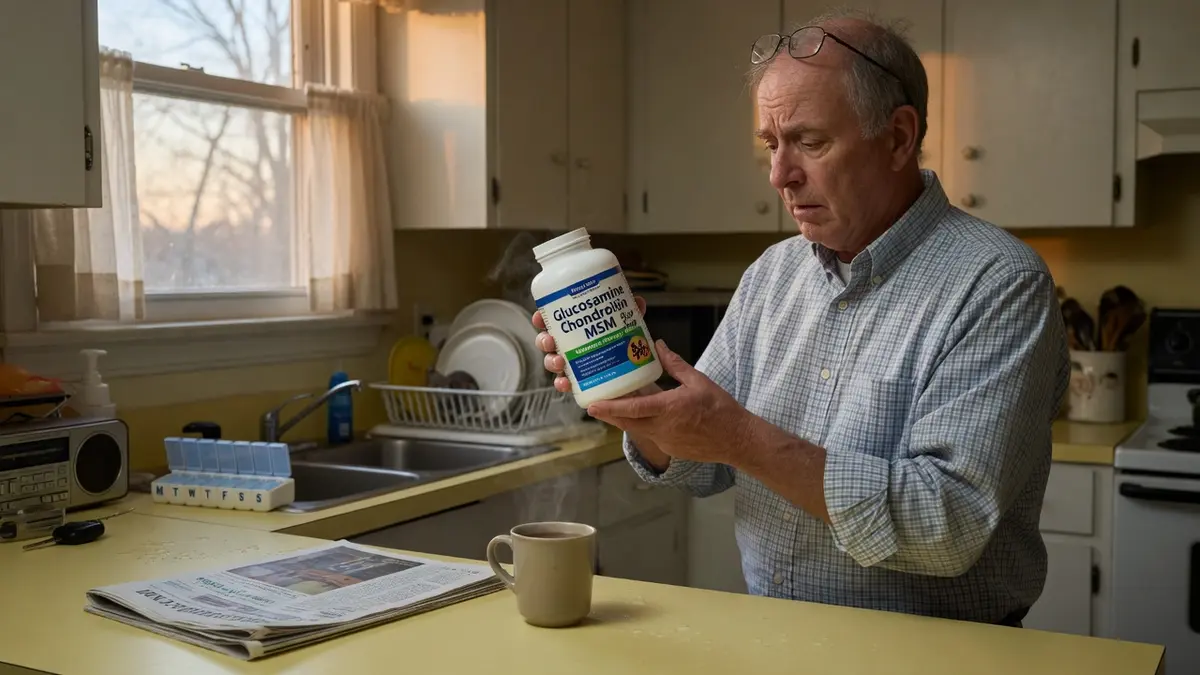
The bottle has probably been sitting in your medicine cabinet for years. You take it for your knees, or your hips, or because a friend swore it helped their hands stop aching. Then a headline lands in your news feed claiming a University of Florida study connects that same supplement to a higher chance of developing Alzheimer’s, and suddenly a simple morning habit feels like a question mark.
So let’s slow down and actually look at what the research shows. The conversation around glucosamine Alzheimer’s risk has been loud, and a lot of that noise skips over what the study could and couldn’t prove. The honest answer is more measured than the headlines suggest — and that matters, because panic rarely leads to good decisions about your health.
What the University of Florida study actually found
Researchers analyzed data from a large health database, looking at adults who reported taking glucosamine supplements and comparing their rates of dementia and Alzheimer’s disease over time against people who didn’t take it. The analysis flagged a statistical association — meaning the glucosamine users showed a somewhat higher rate of being diagnosed with these conditions during the study window.
Here’s the thing about that word, association. It is not the same as cause. The study was observational, which means researchers watched what happened in real-world data rather than randomly assigning people to take glucosamine or a placebo. That design can spot patterns, but it can’t tell you whether the supplement caused the outcome or whether something else entirely is driving the link.
The reported increase in risk was also relatively modest in the context of how this kind of data behaves. Large databases involving hundreds of thousands of people can detect small differences that are statistically real but clinically minor — the kind of signal that’s worth studying further, not the kind that should send anyone into a tailspin.
More Helpful Reads You Might Like:
- Best Supplements for Mental Focus: What Actually Works?
- Vitamin B12 for Energy: Does It Really Help?
- 7 Evidence-Based Zinc Benefits—And Who May Need Supplements
Why glucosamine and dementia might look connected without being linked
This is where the limitations get genuinely important, because they change how you should read the result. Several explanations for the connection between glucosamine and dementia have nothing to do with the supplement being harmful.
Confounding factors
People who take glucosamine tend to share certain traits. They often have chronic joint pain, osteoarthritis, or limited mobility. Reduced physical activity, ongoing pain, and the conditions that come with aging joints are themselves associated with cognitive decline. So the supplement might just be a marker for a population that already carries somewhat higher risk — not the reason for it.
Who chooses to take supplements
Supplement users differ from non-users in ways that are hard to fully account for. Age, other medications, overall health, income, and how often someone sees a doctor all shape both who reaches for glucosamine and who gets a timely dementia diagnosis. Statistical models try to adjust for these, but they can’t catch everything.
Reverse causation
Sometimes the timeline runs backward from what you’d assume. Early, undiagnosed cognitive changes can shift behavior years before a formal diagnosis. Untangling what came first in observational data is notoriously difficult.
None of this means the finding is worthless. It means a single observational study is a reason to ask more questions, not a verdict. The evidence on whether glucosamine affects brain health is genuinely mixed, and some earlier research has even suggested possible anti-inflammatory benefits. Science works by stacking studies, and this is one brick, not the whole wall.
Should I stop taking glucosamine because of this?
For most people, the reasonable answer is no — at least not based on this study alone. If you’ve been wondering “should I stop taking glucosamine,” the more useful question is whether it’s doing anything for you in the first place.
That’s worth being candid about. The evidence that glucosamine meaningfully relieves joint pain is underwhelming. Some people report real improvement, but in well-designed trials, the average benefit over placebo has often been small or hard to detect. Clinical guidelines for osteoarthritis are mixed on recommending it, and several major bodies don’t endorse it for routine use.
So if you’re taking glucosamine, getting clear relief, and tolerating it well, the new data isn’t a strong reason to quit overnight. If you’re taking it out of habit and honestly aren’t sure it helps, this might be a good prompt to reassess — not because it’s been proven dangerous, but because there’s little point continuing a supplement that isn’t earning its place.
Is glucosamine safe, and what about side effects?
Setting the Alzheimer’s question aside, glucosamine has a long track record and is generally well tolerated. When people ask “is glucosamine safe,” the everyday answer for most healthy adults has been yes, with some caveats worth knowing.
Common glucosamine side effects tend to be mild and digestive:
- Nausea or stomach upset
- Heartburn
- Diarrhea or constipation
- Headache
A few situations call for more caution. Many glucosamine products are derived from shellfish, so an allergy matters. The supplement may interact with blood thinners such as warfarin, potentially increasing bleeding risk. And people with diabetes sometimes wonder about effects on blood sugar, though most research hasn’t shown a significant problem at standard doses. If any of these apply to you, that’s a conversation to have with your physician or pharmacist before changing anything.
Glucosamine alternatives for joint pain
If this study nudges you to step back from the supplement, there are well-supported glucosamine alternatives for joint pain that tend to deliver more reliable results.
Movement remains the most evidence-backed approach for osteoarthritis. Low-impact exercise like walking, swimming, or cycling, along with targeted strength work around the affected joint, has consistently been shown to reduce pain and improve function. Weight management helps too — even modest weight loss can meaningfully lighten the load on knees and hips.
For symptom relief, options your doctor might discuss include:
- Topical anti-inflammatory gels, which limit whole-body drug exposure
- Oral pain relievers used appropriately and short-term
- Physical therapy to improve strength and joint mechanics
- Heat and cold for flare-ups
These aren’t magic either, but the supporting evidence is stronger than for most supplements, and they address the joint directly rather than relying on a maybe.
When to talk to your doctor
Reach out to a healthcare provider if you notice joint pain that’s worsening, swelling, redness or warmth around a joint, or pain that’s interfering with sleep and daily activities. These can point to something that needs evaluation rather than self-treatment.
Separately, if you’re noticing genuine changes in memory or thinking — forgetting recent conversations, struggling with familiar tasks, getting lost in familiar places — bring that to a doctor too. Those concerns deserve a proper assessment, and they’re not something to pin on a supplement bottle or to diagnose from a news headline.
How worried should you be about glucosamine Alzheimer’s risk?
The grounded position is this: the glucosamine Alzheimer’s risk reported in the University of Florida study is a signal worth investigating, not a confirmed danger. It comes from observational data with real limitations, the connection may reflect who takes the supplement rather than what it does, and the overall body of evidence is still unsettled. Pair that with the fact that glucosamine’s joint benefits are modest at best, and the practical move for most people is to reassess whether it’s worth taking at all — calmly, and ideally with your doctor’s input rather than in a single anxious afternoon.
Medical Disclaimer: This content is for educational purposes only and does not replace professional medical advice, diagnosis, or treatment. Always consult your physician or a qualified healthcare provider with any questions about a medical condition.
Sources & Further Reading
- Nature Metabolism: Hyperglycosylation is a metabolic driver of Alzheimer’s disease
- UF Health: Study links joint pain supplement to accelerating dementia
- NIH NCCIH: Glucosamine and Chondroitin for Osteoarthritis – What You Need to Know
- National Institute on Aging: Alzheimer’s Disease Fact Sheet
- Mayo Clinic: Mild Cognitive Impairment – Symptoms and Causes
- PubMed / NIH: Habitual glucosamine use, APOE genotypes, and risk of incident cause-specific dementia in the older population