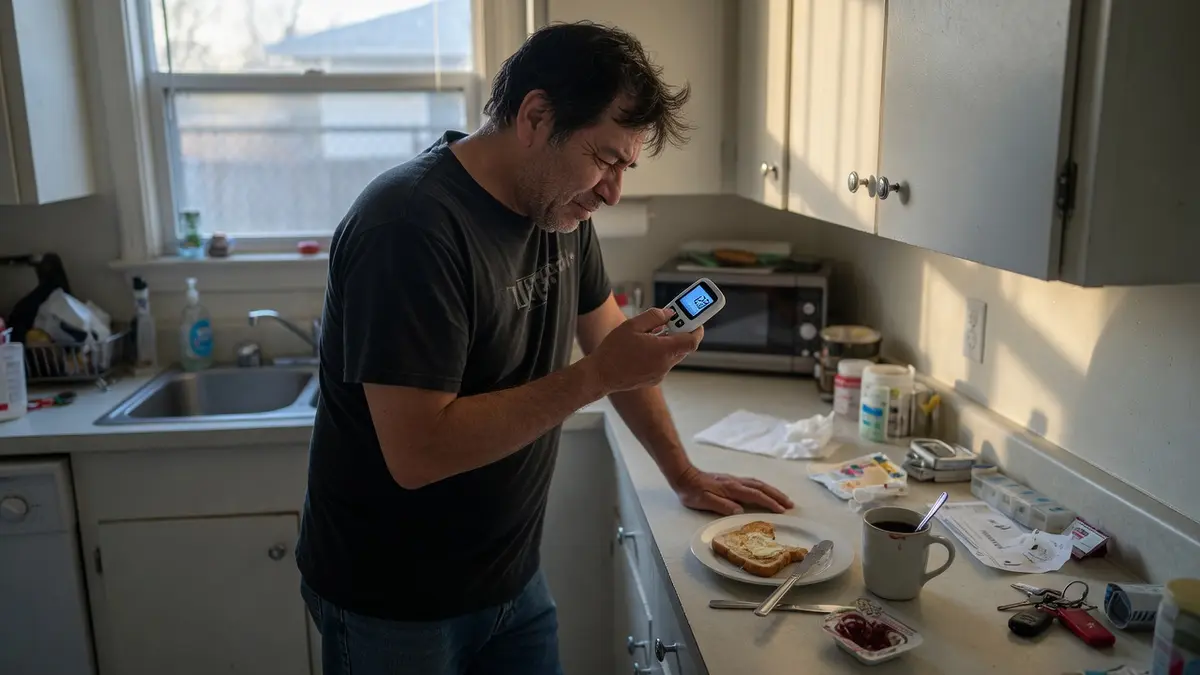
You wake up, prick your finger, and the meter reads 132. Is that good? Bad? You eat breakfast, check again two hours later, and now it’s 165. Did you do something wrong? For anyone who’s just started monitoring glucose, these numbers can feel like a language nobody bothered to teach you. A reading on its own means very little. The same number can be reassuring at one point in the day and a little high at another.
The honest answer to what should blood sugar be throughout the day is that it depends entirely on timing—whether you’ve eaten, how long ago, and what you ate. Blood sugar isn’t supposed to sit at one flat number. It rises and falls all day, even in people without diabetes. The goal isn’t a perfectly still line. It’s keeping those rises and dips within a reasonable range.
How blood sugar moves across a normal day
Glucose—the sugar your body uses for fuel—climbs after you eat and settles back down as insulin moves that sugar into your cells. In someone without diabetes, this happens quietly and quickly. After a meal, levels might rise modestly and return close to baseline within two or three hours. Overnight, with no food coming in, they drift to their lowest steady point, which is why a morning reading taken before eating gives such a useful snapshot.
Blood sugar is measured in milligrams per deciliter (mg/dL) in the U.S. When you see normal blood sugar levels by time of day, the ranges shift depending on the moment you’re testing. That’s the part that trips people up—they compare a post-meal number to a fasting target and panic over nothing.
More Helpful Reads You Might Like:
- Healthy Foods That Still Spike Your Blood Sugar (And Why It Matters)
- What Is Lipoprotein(a) and Why It Matters for Heart Attack Risk
- Why Walking After Meals Is More Powerful Than You Think
Fasting blood sugar range: your morning number
A fasting reading is taken after at least eight hours without eating, usually first thing in the morning. It tells you how your body manages glucose at rest, without food complicating the picture.
For people without diabetes, the fasting blood sugar range is generally considered to be roughly 70 to 99 mg/dL. Readings between 100 and 125 mg/dL fall into what clinicians call prediabetes—a stage where blood sugar is higher than normal but not yet in the diabetes range. Fasting numbers of 126 mg/dL or higher on more than one occasion are often associated with diabetes, though only a physician can confirm that with proper testing.
If you already have diabetes, your target may be different. Many clinical guidelines suggest a fasting goal of around 80 to 130 mg/dL for adults with diabetes, but your doctor may set a tighter or looser range based on your age, other health conditions, and how you respond to treatment.
Why your morning number sometimes looks high
Here’s something that frustrates a lot of newly diagnosed people: fasting numbers can creep up overnight even when you’ve eaten nothing. In the early hours, the body releases hormones that nudge glucose upward to prepare you for waking—sometimes called the dawn phenomenon. A higher-than-expected morning reading doesn’t always mean you did something wrong the night before.
Blood sugar after meals: the post-meal window
This is where timing matters most. Checking right after eating will almost always show a high number, because the food you just digested is still entering your bloodstream. The standard is to test two hours after the first bite of a meal, which gives your body time to start clearing the glucose.
For people without diabetes, blood sugar after meals typically peaks below 140 mg/dL and then drifts back down. For people managing diabetes, many guidelines suggest aiming for under 180 mg/dL at the two-hour mark, though some physicians set a lower target depending on the person.
A few things shape how high you climb after eating:
- What you ate. Refined carbohydrates and sugary drinks spike glucose faster than meals with protein, fat, and fiber.
- How much you ate. Portion size matters as much as food type.
- Movement. A short walk after a meal can blunt the rise, because working muscles pull glucose out of the blood.
- Stress and sleep. Both can raise post-meal numbers in ways that have nothing to do with the plate in front of you.
One high reading after a big meal isn’t a crisis. Patterns matter far more than single numbers, which is why keeping a simple log over a week or two tells you more than any one finger stick.
Pre-meal and before-bed checks
Testing before a meal—when your last meal has mostly cleared—gives a reading similar to your fasting target. For people with diabetes, a common pre-meal goal is in the 80 to 130 mg/dL range, matching the morning aim.
Blood sugar before bed is its own checkpoint, mostly because of what happens while you sleep. The concern overnight is glucose dropping too low without you noticing. Many clinicians suggest a bedtime reading somewhere in the range of about 90 to 150 mg/dL for people on glucose-lowering medication, though the right number for you depends on your treatment. If your bedtime reading runs low and you’re on insulin or certain diabetes pills, a small snack with some protein may help prevent an overnight dip—something worth discussing with your doctor rather than improvising.
What is a dangerous blood sugar level?
Most daily fluctuations are harmless. But there are points where blood sugar moves into territory that needs prompt attention.
On the low end, a reading below 70 mg/dL is considered low blood sugar, or hypoglycemia. Symptoms can include shakiness, sweating, confusion, a racing heart, or sudden hunger. Readings below 54 mg/dL are more serious and can impair your ability to think or function. The standard response to a mild low is the rule of 15—eat about 15 grams of fast-acting carbohydrate, such as juice or glucose tablets, wait 15 minutes, and recheck.
On the high end, what is a dangerous blood sugar level depends partly on symptoms, but readings consistently above 240 mg/dL deserve attention, especially if you feel unwell. Very high glucose can lead to dangerous complications, including a condition called diabetic ketoacidosis, which is more common in type 1 diabetes but can occur in type 2 under stress or illness.
When to seek medical care
- Blood sugar below 54 mg/dL, or a low that doesn’t come back up after treating it twice
- Symptoms of severe low blood sugar—confusion, slurred speech, inability to eat or drink safely, or loss of consciousness (this is an emergency)
- Readings repeatedly above 240 mg/dL, especially with nausea, vomiting, fruity-smelling breath, deep rapid breathing, or extreme thirst
- Glucose numbers that swing widely day to day without a clear reason
- Any reading that worries you alongside feeling genuinely unwell
If someone is unconscious or unable to swallow, call 911 rather than trying to give food or drink.
So what should blood sugar levels be throughout the day for you?
General ranges are a starting point, not a verdict. The numbers above reflect common targets, but your physician may adjust them based on your situation—older adults and people with certain heart or kidney conditions are often given gentler goals to avoid the risks of pushing glucose too low. A teenager newly diagnosed and a 70-year-old with several conditions won’t share the same target sheet.
The most useful habit isn’t chasing a single perfect number. It’s noticing patterns—how a particular breakfast affects you, whether morning readings run high week after week, how a walk changes the post-meal climb. Bring that log to your appointments. It turns a vague conversation into a specific one, and it gives your doctor something far more useful than a single reading taken in the exam room.
Medical Disclaimer: This content is for educational purposes only and does not replace professional medical advice, diagnosis, or treatment. Always consult your physician or a qualified healthcare provider with any questions about a medical condition.