 Written by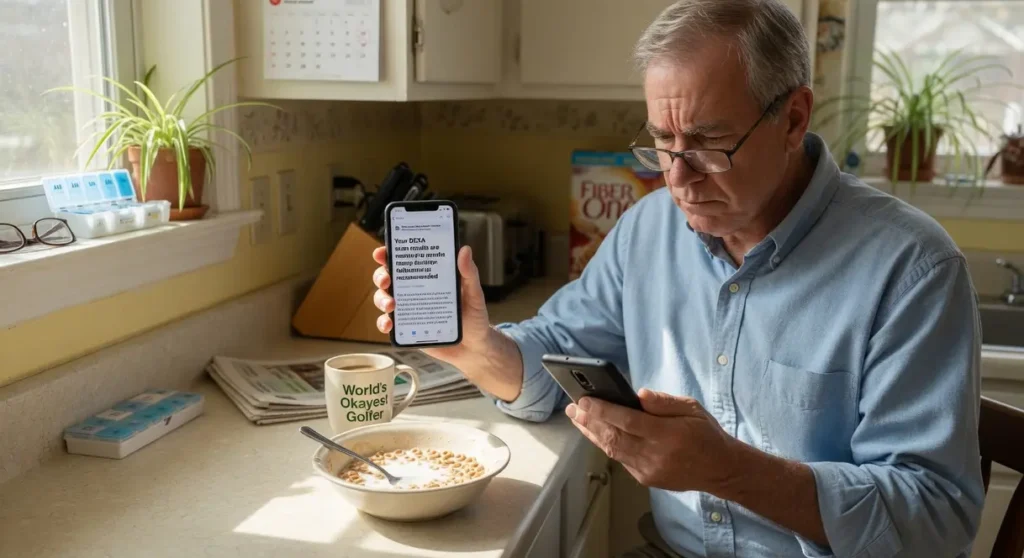
Your primary care doctor mentions a bone density test at your annual visit, and suddenly you’re wondering if your slight loss of height last year was actually meaningful, or whether that wrist fracture from slipping on ice should have prompted this conversation sooner. Bone health isn’t something most adults think about until a doctor brings it up — or until a fracture forces the issue. Knowing who needs a bone density test, what the scan actually measures, and how to read the results can take a lot of the mystery out of that conversation.
In this article
- What a bone density test actually measures
- Who needs a bone density test, according to current guidelines
- When to get a bone density test if you’re under 65
- What the DEXA scan process actually looks like
- T-score meaning and how to read your bone density test results
- What to do with your results
- When to talk to a doctor sooner rather than later
- The bottom line on who needs a bone density test and what to do with the results
What a bone density test actually measures
A bone density test — most commonly a DEXA scan, short for dual-energy X-ray absorptiometry — uses a very low dose of X-rays to measure how much mineral (mostly calcium) is packed into a section of bone. The scan usually focuses on the hip and lower spine, because fractures in those areas are the ones most likely to cause serious problems. It’s quick, painless, and you stay fully clothed. Radiation exposure is roughly a tenth of a standard chest X-ray.
The output is a number called bone mineral density, or BMD. That number gets compared against two reference points: the average BMD of a healthy young adult (your T-score) and the average BMD of someone your own age and sex (your Z-score). Those comparisons are what turn a raw measurement into something clinically useful.
What a DEXA scan can — and can’t — tell you
A DEXA scan can identify osteoporosis, flag the lesser stage called osteopenia, and help estimate fracture risk over the next ten years when combined with other factors like age, weight, smoking status, and family history. What it can’t do is predict exactly when or whether you’ll fracture. Bone density is one important piece of the puzzle, but bone quality, balance, vision, medications, and falls all matter too. Two people with identical T-scores can have very different real-world risks.
Who needs a bone density test, according to current guidelines
Most major U.S. clinical guidelines agree on a core group: women 65 and older, and men 70 and older, regardless of risk factors. The reasoning is straightforward — bone loss accelerates after menopause, and by these ages, enough people have crossed into osteoporosis range that universal screening makes sense.
For adults between 50 and 64, the picture is more individualized. Screening is often recommended earlier if any of the following apply:
- A fracture after age 50 from a minor fall (called a fragility fracture)
- Early menopause, especially before age 45
- Long-term use of oral steroids like prednisone, typically three months or more
- Rheumatoid arthritis, celiac disease, inflammatory bowel disease, or chronic kidney or liver disease
- A parent who had a hip fracture
- Low body weight, generally under 127 pounds for adults of average height
- Current smoking or heavy alcohol use (three or more drinks daily)
- Certain medications, including some breast and prostate cancer treatments, long-term proton pump inhibitors, and some seizure medications
Men under 70 with any of these risk factors are often candidates too, even though osteoporosis is sometimes mistakenly thought of as only a women’s condition. Roughly one in four men over 50 will have an osteoporosis-related fracture in their lifetime.
More Helpful Reads You Might Like:
- 7 Evidence-Based Zinc Benefits—And Who May Need Supplements
- Lipedema Treatment: What Actually Works (And What Doesn’t)
- Peptides for Skin Longevity: How They Really Support Aging Skin
When to get a bone density test if you’re under 65
The honest answer is that timing depends on the combination of risk factors, not any single one. A 55-year-old woman who went through menopause at 42 and has a mother with a hip fracture is in a very different situation than a 55-year-old woman with no risk factors at all. Tools like the FRAX calculator, which estimates ten-year fracture risk, are often used to help decide whether earlier screening is worthwhile.
Anyone who breaks a bone from a low-impact event — tripping over a rug, falling from standing height, lifting something awkwardly — should ask about osteoporosis screening, even if they feel otherwise healthy. Fragility fractures are one of the most reliable signals that bone strength has dropped, and they often go unrecognized as the warning they are.
What the DEXA scan process actually looks like
The scan itself takes about ten to twenty minutes. You lie on a padded table while a scanning arm passes over your hip and lower back. There’s no tunnel, no loud noise, no contrast dye, and no injections. You may be asked to hold a position briefly or to place your feet in a foam block to position the hip correctly. Most people find it less involved than a routine dental X-ray.
Before the scan, you’ll usually be asked to skip calcium supplements for 24 hours and avoid wearing clothes with metal zippers or buttons over the scan area. Results typically come back within a few days.
T-score meaning and how to read your bone density test results
The T-score is the number most people focus on. It compares your bone density to that of a healthy 30-year-old of the same sex, and it’s expressed in standard deviations — basically a measure of how far off the average you are.
- T-score of -1.0 or higher: Considered normal bone density.
- T-score between -1.0 and -2.5: Osteopenia, meaning bone density is lower than ideal but not yet in the osteoporosis range.
- T-score of -2.5 or lower: Osteoporosis.
- T-score of -2.5 or lower with a fragility fracture: Severe or established osteoporosis.
The Z-score compares you to people your own age and sex. In adults over 50, T-scores are used for diagnosis, while Z-scores are more useful for spotting unusual bone loss in younger adults or flagging when a secondary cause — a hidden medical issue driving bone loss — might be at play. A Z-score below -2.0 usually prompts additional workup.
Here’s the thing about osteopenia: it isn’t a disease, and it doesn’t automatically mean medication. Many people with osteopenia never progress to osteoporosis, and treatment decisions depend on overall fracture risk, not the T-score alone.
What to do with your results
A normal result generally means another scan in two to several years, depending on your age and risk profile. Osteopenia often calls for lifestyle steps — weight-bearing and resistance exercise, adequate calcium and vitamin D, fall-prevention strategies, and addressing smoking or excess alcohol — with follow-up scans to track trends. Osteoporosis usually opens a conversation about prescription medications such as bisphosphonates, along with the same lifestyle measures.
Worth knowing: bone density changes slowly. Repeating a DEXA scan too soon, say within a year, often won’t show meaningful differences and can lead to confusion. Most follow-up scans are spaced at least two years apart unless there’s a specific reason to check sooner.
When to talk to a doctor sooner rather than later
Certain situations warrant a prompt conversation rather than waiting for the next routine visit. These include a fracture from a minor fall at any age over 50, a noticeable loss of height (more than about an inch and a half from your peak adult height), new or worsening upper-back curvature, persistent back pain without an obvious cause, or starting a medication known to weaken bone — particularly long-term steroids or hormone-blocking cancer therapies.
Sudden, severe back pain after a minor movement deserves urgent evaluation, since it can occasionally signal a vertebral compression fracture, which is sometimes the first sign of undiagnosed osteoporosis.
The bottom line on who needs a bone density test and what to do with the results
Bone density testing isn’t useful for everyone at every age, but it’s genuinely valuable for the people who fit the risk profile — and the cost of skipping it when it’s indicated can be a fracture that changes daily life. If you’re 65 or older (or a man 70 or older), the answer is almost always yes. If you’re between 50 and 65, the question is whether your risk factors add up enough to make screening worthwhile, and that’s a conversation worth having with your doctor specifically, not in the abstract.
Medical Disclaimer: This content is for educational purposes only and does not replace professional medical advice, diagnosis, or treatment. Always consult your physician or a qualified healthcare provider with any questions about a medical condition.
Sources & Further Reading
How we sourced this article: we rely on peer-reviewed studies, clinical guidelines and public-health agencies (CDC, NIH, AHA, WHO), check every link before publishing, and update articles when the evidence changes. Read our editorial approach.
- U.S. Preventive Services Task Force: Osteoporosis to Prevent Fractures: Screening (2025 Final Recommendation)
- NIH NIAMS: Bone Mineral Density Tests: What the Numbers Mean
- CDC: Facts About Bone Density (DEXA Scan)
- Bone Health and Osteoporosis Foundation: Bone Density Test, Osteoporosis Screening & T-score Interpretation
- Mayo Clinic News Network: Who Should Have a Bone Density Test?