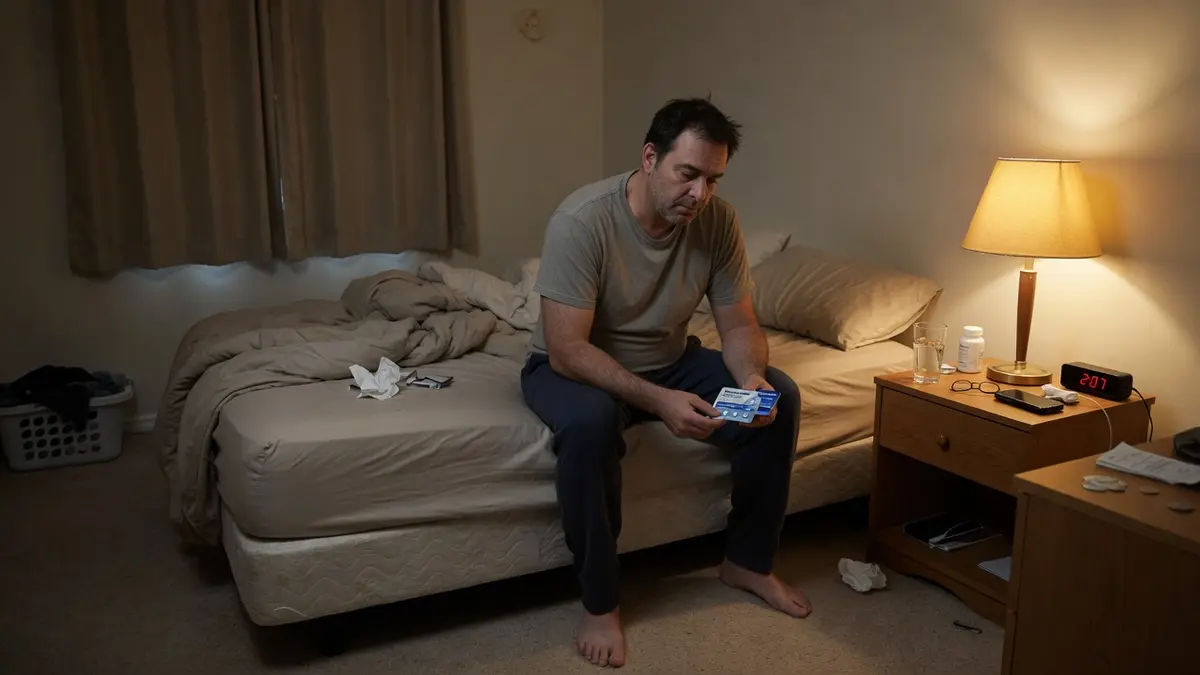

The overhead lights at the grocery store feel like they’re drilling into the back of your eyes. Your kid asks a question in a perfectly normal voice, and it lands like a slammed door. You retreat to a dark bedroom, pull the blanket over your head, and finally—finally—things stop screaming at you. If that sequence is familiar, there’s a real neurological reason for it, and understanding it can be surprisingly reassuring.
The short version of why migraines cause light and sound sensitivity is that a migraine isn’t just a bad headache happening in one spot. It’s a temporary shift in how the whole brain processes incoming signals. During an attack, the brain becomes more excitable and less able to filter ordinary input, so light and sound stop feeling ordinary. They feel like assault.
What happens in your brain during a migraine
To understand the sensory piece, it helps to know that a migraine involves several brain systems firing in ways they normally wouldn’t. Researchers describe the migraine brain as being in a state of hyperexcitability—meaning neurons (the cells that carry signals) respond more easily and more intensely to stimulation than they otherwise would. This tendency appears to exist between attacks too, not just during them, which may be part of why some people are chronically a bit more sensitive to bright or loud environments.
Then there’s the trigeminal system. The trigeminal nerve is the major sensory nerve of the face and head, and it plays a central role in migraine pain. When it becomes activated and inflamed during an attack, it doesn’t stay in its lane. The signals spread and amplify in a process often called central sensitization—basically, the nervous system’s volume knob gets cranked up, so inputs that are normally neutral start registering as painful. This is why, mid-migraine, brushing your hair or resting your face on a pillow can hurt. The same amplification affects how you process light and sound.
More Helpful Reads You Might Like:
- Period Migraines: Why They Hit Harder and What Actually Helps
- Why Acid Reflux Gets Worse at Night—and What Actually Helps
- Can You Cure Lactose Intolerance? What Actually Works
Why light hurts during a migraine
Photophobia—discomfort or pain triggered by light—is one of the most common features of migraine, reported by a large majority of people who get them. And the mechanism is genuinely interesting, because it doesn’t work the way you’d expect.
You might assume light-induced pain travels through the same visual pathway that lets you see. But research points to a separate route. There’s a specialized type of cell in the retina (the light-sensitive layer at the back of the eye) that responds to light without contributing much to actual vision. These cells connect to brain regions involved in pain processing rather than image processing. During a migraine, when those pain pathways are already sensitized, signals from these light-detecting cells appear to feed directly into the misery.
Two clues support this. First, some people who are completely blind—but who still have functioning light-sensing retinal cells—report that light worsens their migraine pain, even though they can’t see the light. Second, studies have found that certain colors of light, particularly blue and white, tend to intensify migraine discomfort more than others, while a narrow band of green light sometimes bothers people less. That’s not because green is magical. It’s because different wavelengths activate these pathways to different degrees.
What this means practically
The takeaway isn’t that you should chase after special green light bulbs. It’s that dimming and softening your environment during an attack is doing something real at the level of your nervous system, not just making you feel cozy. A few things people find genuinely useful:
- A dark, quiet room during an active attack, which reduces the input feeding an already-overloaded system.
- Reducing screen brightness and using warmer color settings, since screens are a common source of the blue-white light that tends to aggravate photophobia during migraine.
- Sunglasses outdoors—but not indoors all day, because constantly shielding your eyes from normal light can, over time, make you more sensitive rather than less. This is one of those counterintuitive things: wearing dark glasses around the house between attacks may backfire.
Why sound feels unbearable too
Migraine sensitivity to noise, called phonophobia, runs on a parallel track. The same central sensitization that amplifies pain and light also affects how the auditory system handles sound. Ordinary background noise—traffic, a television, a dishwasher—stops being background. The brain, in its hyperexcitable state, struggles to filter and dampen these signals the way it normally does.
Some people also notice sensitivity to smells (osmophobia) or to touch during the same attack. That clustering is a strong hint that this isn’t about any single sense being broken. It’s about a whole shift in sensory processing. The migraine brain is temporarily bad at deciding what deserves attention and what can be ignored, so everything gets flagged as important, and important quickly becomes overwhelming.
Worth knowing: sensory sensitivity can show up before the head pain, during what’s called the prodrome (the early warning phase). If light or sound starts bothering you unusually and a headache tends to follow, that early sensitivity can actually serve as a useful signal to start whatever your treatment plan is, when interventions often work best.
This isn’t oversensitivity or weakness
Here’s the part that matters if you’ve ever been told you’re being dramatic. Retreating from light and sound during a migraine is not an overreaction or a personality quirk. It’s a measurable biological response involving identifiable brain pathways. The discomfort is real, the mechanism is documented, and the instinct to seek darkness and quiet is your nervous system asking for exactly what reduces the load on it.
That reframing has practical value. People who understand the sensory sensitivity as a feature of the attack—rather than as a failing—tend to manage it more calmly and advocate for themselves more effectively at work and at home.
When to seek medical care
Sensory sensitivity that comes and goes with your typical migraine pattern is generally consistent with migraine. Certain situations, though, warrant prompt medical attention:
- A sudden, severe headache that peaks within seconds to a minute—sometimes described as the worst headache of your life.
- Light or sound sensitivity accompanied by a stiff neck, fever, confusion, or a rash.
- New neurological symptoms such as weakness on one side, trouble speaking, or vision loss that doesn’t resolve.
- A clear change in your usual headache pattern, or new headaches starting after age 50.
- Sensitivity and headaches that are becoming more frequent or no longer respond to your usual approach.
A clinician can confirm the diagnosis, rule out other causes, and discuss both acute treatments and preventive options. Several prescription medications developed specifically for migraine target the very pathways involved in this sensory amplification, and they’ve meaningfully changed what’s possible for many people.
Why migraines cause light and sound sensitivity, in one honest sentence
The reason light and sound become unbearable during an attack is that a migraine turns up the sensitivity of the brain’s pain and sensory systems while turning down its ability to filter—so ordinary input gets routed into pathways built for pain. Knowing that won’t stop the next attack, but it does tell you something useful: the dark, quiet room isn’t hiding. It’s treatment.
Medical Disclaimer: This content is for educational purposes only and does not replace professional medical advice, diagnosis, or treatment. Always consult your physician or a qualified healthcare provider with any questions about a medical condition.
Sources & Further Reading
- PMC / NIH: Advances in Understanding the Mechanisms of Migraine-Type Photophobia
- PMC / NIH: Sensitization of the Trigeminovascular Pathway: Perspective and Implications to Migraine Pathophysiology
- PubMed: Phonophobia in Migraine
- American Migraine Foundation: Photophobia (Light Sensitivity) and Migraine
- Mayo Clinic: Migraine – Symptoms and Causes
- NINDS / NIH: Migraine